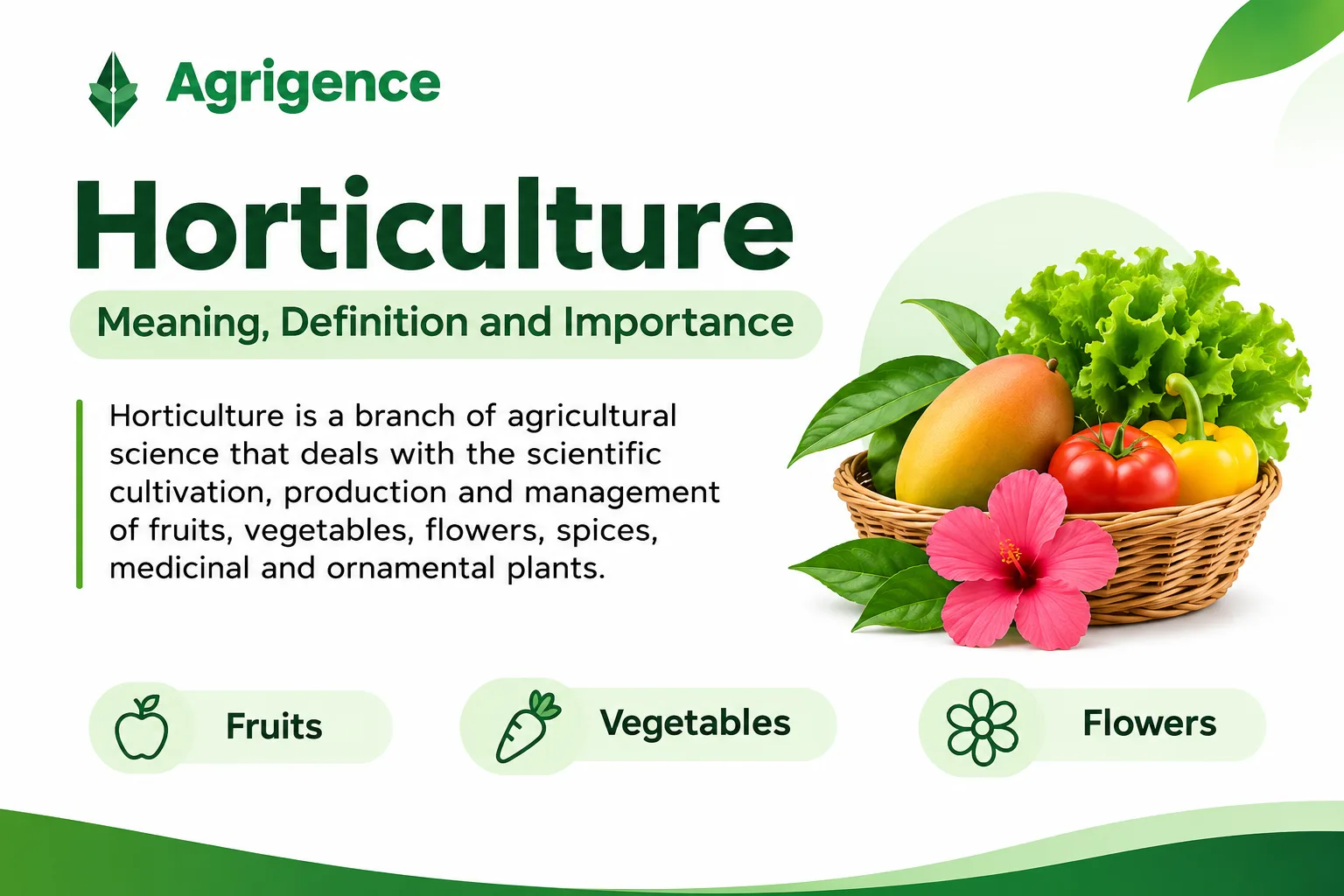
Have you ever wondered how fruits, vegetables, flowers, medicinal plants and ornamental gardens are produced scientifically? How are mango orchards established, how are high-quality vegetables grown in polyhouses, and how are flowers cultivated commercially?
The science behind these activities is known as Horticulture.
Horticulture is one of the most important branches of agricultural science. It deals with the cultivation, production, improvement, management and utilization of fruits, vegetables, flowers, ornamental plants, spices, plantation crops, medicinal plants and aromatic plants.
Unlike the conventional image of gardening, modern horticulture is a highly developed scientific and commercial discipline. It incorporates plant breeding, biotechnology, soil science, plant physiology, irrigation management, protected cultivation, post-harvest technology, processing and marketing.
Horticulture contributes to food and nutritional security, employment generation, economic development, environmental improvement and sustainable agricultural practices.
In this article, we will understand the meaning of horticulture, explore its definitions given by renowned horticultural scientists and institutions, examine its major branches and discuss its importance in agriculture and human life.
1. What Is Horticulture?
Horticulture is a branch of agricultural science that deals with the scientific cultivation, production, improvement, management and utilization of fruits, vegetables, flowers, ornamental plants, spices, plantation crops, medicinal plants and aromatic plants.
It involves the application of scientific knowledge, modern technologies and management practices to improve the growth, productivity, quality, nutritional value and economic returns of horticultural crops.
Horticulture is not limited to growing plants in household gardens. It also includes large-scale commercial orchards, vegetable farms, nurseries, greenhouses, polyhouses, shade-net structures, landscaping projects and modern protected cultivation systems.
For example:
- Growing mango, guava, banana and citrus is part of fruit science.
- Producing tomato, chilli, cabbage and cauliflower comes under vegetable science.
- Commercial cultivation of rose, marigold and carnation falls under floriculture.
- Growing turmeric, ginger and black pepper is associated with spices and plantation-related horticulture.
- Cultivating medicinal and aromatic plants such as ashwagandha, lemongrass and aloe vera is another important area.
- Designing and maintaining parks, gardens and green spaces comes under landscape horticulture.
Thus, horticulture combines science, technology, art and commercial enterprise to make better use of plant resources for human welfare.
2. Meaning and Origin of the Word Horticulture
The word Horticulture has its origin in Latin.
It is commonly explained through two Latin words:
- Hortus: Meaning garden or an enclosed area.
- Cultura: Meaning cultivation or growing.
The word cultura is associated with the Latin verb colere, meaning to cultivate or take care of.
Therefore, horticulture literally refers to the cultivation of plants in a garden or enclosed area.
Historically, fruits, vegetables and flowers were often cultivated in gardens or protected areas near human settlements, while cereals such as wheat, rice and maize were generally cultivated in larger open fields.
Over time, horticulture developed beyond traditional garden cultivation into a specialized branch of agricultural science involving commercial production, scientific plant management, research, post-harvest handling and marketing.
Horticulture meaning in Hindi
Horticulture is commonly translated into Hindi as:
- उद्यानिकी
- उद्यान विज्ञान
- बागवानी
- उद्यान कृषि
In agricultural education, उद्यानिकी (Udyaniki) and उद्यान विज्ञान (Udyan Vigyan) are widely used technical expressions.
In simple Hindi:
हॉर्टिकल्चर या उद्यानिकी कृषि विज्ञान की वह शाखा है जिसके अंतर्गत फल, सब्जियों, फूलों, मसालों, औषधीय एवं सुगंधित पौधों तथा सजावटी पौधों की वैज्ञानिक खेती, उत्पादन, सुधार एवं प्रबंधन का अध्ययन किया जाता है।
Horticulture meaning in Tamil
In Tamil, horticulture is known as:
தோட்டக்கலை (Thottakkalai)
It refers to the cultivation, production and management of fruits, vegetables, flowers and other garden plants.
3. Definitions of Horticulture by Different Scientists and Institutions
There is no single universally worded definition of horticulture. Different scholars and scientific organizations describe it from different perspectives, including plant cultivation, scientific production, commercial management, technology and human welfare.
The following are seven important definitions and descriptions from recognized academic and institutional sources.
3.1 Definition Given by Liberty Hyde Bailey
Liberty Hyde Bailey (1858–1954) was a distinguished American horticulturist, botanist, educator and agricultural scientist.
According to Liberty Hyde Bailey, as quoted in the CBSE Basic Horticulture-I Student Handbook:
"Horticulture is the growing of flowers, fruits and vegetables, and of plants for ornament and fancy."
Explanation: Bailey's definition emphasizes the traditional scope of horticulture, particularly the cultivation of fruits, vegetables and ornamental plants. It recognizes both the productive and aesthetic purposes of growing plants.
Source: CBSE, Basic Horticulture-I, Student Handbook, Class XI, Chapter 1: Introduction to Horticulture.
3.2 Definition Given by Webster's Dictionary
Webster's Dictionary defines horticulture as:
"The science and art of growing fruits, vegetables, and flowers."
Explanation: This definition highlights two fundamental aspects of horticulture:
- Science: Application of plant physiology, genetics, soil science, plant nutrition, crop protection and modern production technologies.
- Art: Practical skills involved in plant training, pruning, landscaping, garden design, propagation and aesthetic plant management.
It establishes that horticulture is not simply gardening; it is a combination of scientific knowledge and practical expertise.
Source: Webster's Dictionary definition as reproduced in the CBSE Basic Horticulture-I Student Handbook, Chapter 1.
3.3 Definition Given by the United States Department of Agriculture (USDA)
The United States Department of Agriculture (USDA), in its document on specialty crops, describes horticulture as a branch of agriculture concerned with growing plants used by people for:
- Food
- Medicinal purposes
- Aesthetic gratification
Explanation: This definition expands the scope of horticulture beyond food production. It recognizes the importance of medicinal plants and ornamental plants in human life.
For example, vegetables and fruits fulfil nutritional needs, medicinal plants provide raw materials for herbal and pharmaceutical industries, and flowers and ornamental plants improve the beauty of residential and public spaces.
Source: USDA Agricultural Marketing Service, USDA Definition of Specialty Crop.
3.4 Definition Given by the American Society for Horticultural Science (ASHS)
The American Society for Horticultural Science defines horticulture as a branch of agriculture involving the art, economics, management, practice, science and technology of producing specialty plants for food, medicine, ornamental purposes and other human benefits.
Explanation: This is a broader modern definition. It emphasizes that horticulture includes not only cultivation but also:
- Scientific research and crop improvement
- Commercial production and enterprise management
- Marketing and economics
- Production technology
- Human health and environmental benefits
This definition is particularly relevant to modern commercial horticulture, research and agribusiness development.
Source: American Society for Horticultural Science, ASHS Publications Style Manual, 2022, Chapter 1: Horticulture.
3.5 Definition Given by the International Commission on Irrigation and Drainage (ICID)
The International Commission on Irrigation and Drainage describes horticulture as the science, art, technology and business involved in the intensive cultivation of plants for human use.
Explanation: This definition highlights the four major dimensions of modern horticulture:
- Science – Understanding plant growth and development.
- Art – Applying practical knowledge to plant cultivation and landscaping.
- Technology – Using modern irrigation, protected cultivation, biotechnology and precision farming.
- Business – Managing production, supply chains, processing, marketing and trade.
It also recognizes that horticulture operates at different scales, from individual gardens to multinational commercial enterprises.
Source: International Commission on Irrigation and Drainage (ICID), Basic Information: Horticulture.
3.6 Definition Given by the Authors of The Science of Plants
The textbook The Science of Plants: Understanding Plants and How They Grow, published by the University of Minnesota, describes horticulture as the art and science of developing, sustainably producing, marketing and utilizing high-value, intensively cultivated food and ornamental plants.
The book is authored by:
- Dr. Tom Michaels
- Matt Clark
- Dr. Emily Hoover
- Laura Irish
- Alan Smith
- Emily Tepe
Explanation: This definition highlights sustainable production, commercial value and the importance of both edible and ornamental plants. It also connects horticulture with marketing and the efficient use of plant resources.
Source: University of Minnesota, The Science of Plants, 2022, Chapter 1.1: What Is Horticulture?
3.7 Definition Presented by G. Uma and Mita Sinhamahapatra
In Unit 10, Horticulture, of the educational resource Introduction to Agriculture and Allied Sectors, the authors G. Uma and Mita Sinhamahapatra explain horticulture as the science and art of gardening involving the cultivation of fruits, vegetables, flowers and ornamental plants.
Their discussion also incorporates processing and value addition of horticultural products for domestic and export markets.
Explanation: This perspective is particularly relevant to Indian agriculture because it connects horticultural production with processing, value addition, employment and agricultural entrepreneurship.
Source: eGyanKosh, Introduction to Agriculture and Allied Sectors, Unit 10: Horticulture.
Comparison of the Seven Definitions
| Scientist / Institution | Main emphasis |
|---|---|
| Liberty Hyde Bailey | Flowers, fruits, vegetables and ornamental plants |
| Webster's Dictionary | Science and art of cultivation |
| USDA | Food, medicinal and aesthetic purposes |
| ASHS | Science, economics, management and technology |
| ICID | Science, art, technology and business |
| University of Minnesota authors | Sustainable production, marketing and utilization |
| G. Uma and Mita Sinhamahapatra | Cultivation, processing and value addition |
A comprehensive definition of horticulture:
Considering the above definitions, horticulture can be understood as the branch of agricultural science concerned with the scientific and commercial production, improvement, management, processing, marketing and utilization of high-value food and non-food plants, including fruits, vegetables, flowers, ornamental plants, spices, plantation crops, medicinal plants and aromatic plants, for improving human nutrition, economic development and environmental quality.
4. Major Branches of Horticulture
Horticulture is a broad discipline divided into several specialized branches according to the crops cultivated and their purposes.
4.1 Pomology (Fruit Science)
Pomology is the branch of horticulture dealing with the scientific study, cultivation, production, improvement and management of fruit crops.
It includes orchard establishment, selection of varieties and rootstocks, propagation, canopy management, pruning, training, irrigation, nutrient management and post-harvest handling.
Examples:
- Mango
- Guava
- Banana
- Citrus
- Apple
- Grape
- Papaya
- Pomegranate
4.2 Olericulture (Vegetable Science)
Olericulture deals with the scientific cultivation, production, improvement and management of vegetable crops.
It covers nursery raising, seed production, transplanting, spacing, irrigation, fertilization, crop protection, harvesting and marketing.
Examples:
- Tomato
- Brinjal
- Chilli
- Cauliflower
- Cabbage
- Potato
- Onion
- Cucumber
4.3 Floriculture (Flower Science)
Floriculture is the branch of horticulture concerned with the production, improvement and marketing of flowers and ornamental flowering plants.
It includes cut flowers, loose flowers, potted plants, nursery production and commercial flower cultivation.
Examples:
- Rose
- Marigold
- Chrysanthemum
- Carnation
- Gerbera
- Gladiolus
- Jasmine
- Orchid
4.4 Landscape Horticulture
Landscape horticulture deals with the planning, establishment, development and maintenance of gardens, parks, lawns and other green spaces.
It combines horticultural knowledge with landscape design to improve the aesthetic and functional quality of outdoor and indoor environments.
4.5 Arboriculture
Arboriculture is the study and management of individual trees, shrubs, vines and other perennial woody plants.
It includes planting, pruning, tree health management, structural maintenance and preservation of trees in urban and rural environments.
4.6 Plantation Crops
This branch deals with the cultivation and management of commercial perennial crops, often grown on plantations or organized farms.
Examples:
- Tea
- Coffee
- Coconut
- Arecanut
- Cashew
- Cocoa
- Rubber
The classification of certain plantation crops may vary across horticultural and agricultural frameworks.
4.7 Spices and Condiment Crops
This area deals with the production and management of crops used for flavouring, seasoning, colouring and other culinary purposes.
Examples:
- Turmeric
- Ginger
- Black pepper
- Cardamom
- Coriander
- Cumin
- Garlic
4.8 Medicinal and Aromatic Plants
This branch focuses on plants cultivated for medicinal compounds, essential oils, fragrance and other industrial uses.
Examples:
- Ashwagandha
- Aloe vera
- Tulsi
- Lemongrass
- Mentha
- Vetiver
- Senna
4.9 Post-Harvest Management
Post-harvest management deals with the handling of horticultural produce after harvesting.
It includes:
- Cleaning and grading
- Sorting
- Packaging
- Pre-cooling
- Storage
- Transportation
- Processing
- Value addition
- Supply-chain management
The major objective is to maintain quality, reduce post-harvest losses and improve the market value of horticultural produce.
5. Importance of Horticulture in Agriculture and Human Life
Horticulture is important not only for agricultural development but also for nutrition, employment, economic growth, environmental protection and improved quality of life.
Its importance can be understood through the following aspects.
5.1 Nutritional Security and Balanced Diet
Horticultural crops are important sources of essential nutrients required for human health.
Fruits and vegetables provide vitamins, minerals, dietary fibre, antioxidants and other bioactive compounds.
For example:
- Citrus fruits are important sources of vitamin C.
- Carrot provides beta-carotene, a precursor of vitamin A.
- Green leafy vegetables provide folates, minerals and dietary fibre.
- Banana provides potassium and carbohydrates.
- Tomato contains lycopene.
- Amla is a rich source of vitamin C.
Regular consumption of a diverse range of fruits and vegetables supports a balanced diet and helps address micronutrient deficiencies.
Therefore, horticulture plays a significant role in improving nutritional security.
5.2 Economic Importance
Horticulture is an important source of agricultural income.
Many horticultural crops generate higher economic returns per unit area than several conventional field crops, although profitability depends on location, investment, market demand, production costs and crop management.
Commercial cultivation of fruits, vegetables, flowers, spices and medicinal plants provides opportunities for farmers to diversify their income.
Examples include:
- Commercial mango orchards
- High-density guava cultivation
- Protected cultivation of capsicum and cucumber
- Strawberry production
- Commercial rose cultivation
- Turmeric and ginger farming
Horticultural enterprises also create opportunities in nursery management, seed production, processing, packaging and marketing.
5.3 Employment Generation
Horticulture is a labour-intensive sector that creates employment opportunities throughout the production and marketing chain.
Employment is generated in:
- Nursery and planting-material production
- Orchard establishment and maintenance
- Vegetable cultivation
- Flower production
- Protected cultivation
- Harvesting and grading
- Packaging and transportation
- Food processing
- Retail marketing and exports
It provides opportunities for farmers, farm workers, horticulturists, entrepreneurs, researchers and technical professionals.
5.4 Environmental Importance
Horticulture contributes to environmental improvement through the establishment and maintenance of green spaces, orchards, urban gardens and landscape plantations.
Trees and vegetation can:
- Capture and store atmospheric carbon.
- Provide shade and moderate local temperatures.
- Support biodiversity and pollinators.
- Reduce soil erosion.
- Improve the visual quality of landscapes.
- Provide habitats for beneficial organisms.
Sustainable horticultural practices, including mulching, efficient irrigation, integrated nutrient management and integrated pest management, can further improve resource-use efficiency.
5.5 Improvement of Farmers' Income
Crop diversification is an important strategy for reducing farmers' dependence on a single crop.
Farmers can integrate horticultural crops with existing agricultural systems to utilize their available land, labour and water more efficiently.
For example, farmers can cultivate vegetables between young fruit trees during the orchard establishment phase, subject to appropriate spacing and resource availability.
Other opportunities include:
- Intercropping in orchards
- High-density planting
- Off-season vegetable cultivation
- Protected cultivation
- Nursery enterprises
- Organic and residue-conscious horticulture
These practices can support additional income streams when properly planned and managed.
5.6 Growth of Agro-Based Industries
Horticulture supports several agro-based industries through the supply of raw materials.
Examples include:
- Fruit juice and beverage industries
- Jam and jelly manufacturing
- Pickle production
- Dehydrated vegetable processing
- Frozen food industries
- Essential oil extraction
- Herbal product manufacturing
- Flower processing and decoration
- Nursery and planting-material industries
Processing and value addition increase the utility and market opportunities of horticultural produce.
5.7 Export Promotion and Foreign Exchange
Many horticultural products have strong domestic and international market potential.
Fresh fruits, vegetables, spices, flowers, processed products and medicinal plant materials can generate export opportunities.
Quality production, grading, packaging, cold-chain infrastructure, traceability and compliance with phytosanitary and food-safety requirements are essential for improving export competitiveness.
5.8 Women Empowerment and Rural Entrepreneurship
Horticulture creates opportunities for women in both farm-based and non-farm enterprises.
Women can participate in:
- Vegetable nurseries
- Mushroom production
- Floriculture
- Vegetable processing
- Pickle and jam preparation
- Herbal product enterprises
- Seedling production
- Urban gardening
- Flower decoration and marketing
Small-scale horticultural enterprises can contribute to rural employment, entrepreneurship and household income diversification.
5.9 Improvement of Livelihoods in Small and Marginal Farms
Horticulture offers opportunities to diversify production on relatively small landholdings.
With suitable crop selection, market access, water management and technical guidance, small and marginal farmers can establish productive orchards, vegetable units and nursery enterprises.
Integrated horticultural farming systems can also combine fruit trees, vegetables, spices, medicinal plants and other compatible enterprises.
5.10 Contribution to Sustainable Agriculture
Modern horticulture increasingly integrates sustainable and resource-efficient production practices.
Important approaches include:
- Drip irrigation and fertigation
- Rainwater harvesting
- Mulching
- Integrated nutrient management
- Integrated pest management
- Protected cultivation
- Soil organic matter improvement
- Crop diversification
- Climate-smart production
- Efficient post-harvest management
These approaches help improve productivity while supporting the efficient use of land, water, nutrients and other agricultural resources.
6. Difference Between Agriculture, Agronomy and Horticulture
Agriculture, agronomy and horticulture are closely related, but they are not identical.
| Basis | Agriculture | Agronomy | Horticulture |
|---|---|---|---|
| Meaning | Broad field involving crop and livestock production and related activities | Science of field-crop production and soil management | Science and art of cultivating specialty food and non-food plants |
| Main focus | Overall agricultural production | Field crops and resource management | Fruits, vegetables, flowers and other horticultural crops |
| Crops | Includes field crops and horticultural crops | Commonly cereals, pulses, oilseeds and fibre crops | Fruits, vegetables, flowers, spices and ornamental crops |
| Production systems | Diverse systems | Usually extensive field production, though systems vary | Often intensive and specialized production |
| Management | Broad agricultural management | Crop and soil management | Specialized plant, orchard, nursery and landscape management |
| Examples | Crop production, livestock and allied activities | Wheat, rice, maize, soybean | Mango, tomato, rose, banana and capsicum |
Important: Horticulture is a part of agriculture. The distinction between horticulture and agronomy is based mainly on crop type, production purpose and management system. It is not determined exclusively by farm size.
For example, commercial vegetable cultivation on a large farm is still horticulture, while grain maize cultivation is generally classified under agronomy.
7. Scope of Horticulture in Modern Agriculture
The scope of horticulture is expanding with the development of modern agricultural technologies, increasing consumer demand and the growth of agricultural markets.
Some major emerging areas include:
- Protected cultivation: Production of vegetables and flowers under polyhouses, greenhouses and shade-net structures.
- Precision horticulture: Use of sensors, automation, satellite data and digital monitoring for crop management.
- Hydroponics and soilless cultivation: Production of crops using nutrient solutions and suitable growing substrates.
- High-density planting: Establishment of orchards using suitable varieties, rootstocks and scientific canopy-management systems.
- Tissue culture: Mass propagation of quality planting material under controlled laboratory conditions.
- Organic and sustainable horticulture: Production systems focused on soil health, nutrient recycling and responsible crop protection.
- Post-harvest technology: Development of improved packaging, storage, processing and cold-chain systems.
- Urban horticulture: Rooftop gardens, vertical gardens, community gardens and urban landscape development.
- Digital and AI-based horticulture: Use of artificial intelligence, computer vision and decision-support systems for disease detection, irrigation scheduling and crop monitoring.
These developments are creating new opportunities for horticulturists, agricultural graduates, researchers, farmers and agripreneurs.
8. Career Opportunities in Horticulture
Horticulture offers career opportunities in government departments, agricultural universities, research institutions, private companies, nurseries, agribusinesses and entrepreneurship.
Some major career options include:
- Horticulture Officer
- Assistant Director of Horticulture
- Horticulturist
- Pomologist
- Vegetable Scientist
- Floriculturist
- Plant Breeder
- Nursery Manager
- Protected Cultivation Specialist
- Landscape Designer
- Post-Harvest Technologist
- Agricultural Researcher
- Horticultural Extension Specialist
- Agribusiness Entrepreneur
Students can pursue B.Sc. Horticulture, M.Sc. Horticulture and doctoral research in specialized horticultural disciplines.
9. Conclusion
Horticulture is much more than the cultivation of fruits, vegetables and flowers. It is a comprehensive branch of agricultural science that integrates plant production, scientific research, technology, commercial management, processing and marketing.
From traditional orchards and vegetable gardens to modern polyhouses, precision farming, tissue culture laboratories and commercial nurseries, horticulture plays an important role in agricultural development.
Its contribution to nutritional security, farmers' income, employment generation, rural entrepreneurship, environmental improvement and sustainable agriculture makes it an essential component of the modern agricultural system.
With technological advancement, changing food preferences and increasing demand for high-quality horticultural products, the scope of horticulture will continue to expand in India and globally.
Horticulture is not merely about growing plants; it is about improving human life through the scientific, sustainable and productive utilization of plant resources.
Frequently Asked Questions (FAQs)
1. What is horticulture?
Horticulture is a branch of agricultural science concerned with the scientific production, cultivation, improvement, management and utilization of fruits, vegetables, flowers, ornamental plants, spices, medicinal plants and other specialty crops.
2. What is the meaning of horticulture in Hindi?
Horticulture means उद्यानिकी, उद्यान विज्ञान or बागवानी in Hindi.
3. What is the meaning of horticulture in Tamil?
Horticulture is known as தோட்டக்கலை (Thottakkalai) in Tamil.
4. Who is known for the classic definition of horticulture?
Liberty Hyde Bailey gave a well-known classic description of horticulture emphasizing the growing of flowers, fruits, vegetables and plants for ornamental purposes.
5. What are the major branches of horticulture?
The major branches include pomology, olericulture, floriculture, landscape horticulture, arboriculture, plantation crops, spices, medicinal and aromatic plants, and post-harvest management.
6. Why is horticulture important in agriculture?
Horticulture contributes to nutritional security, agricultural diversification, farmers' income, rural employment, export opportunities, environmental improvement and sustainable agricultural development.
7. What is the difference between horticulture and agriculture?
Agriculture is the broader field of crop production, livestock and related activities. Horticulture is a specialized branch of agriculture concerned with the cultivation and management of fruits, vegetables, flowers and other specialty plants.
8. What is the scope of horticulture in India?
Horticulture has a broad scope in India, including fruit production, vegetable cultivation, floriculture, protected cultivation, nursery management, plant breeding, processing, export, research and agricultural entrepreneurship.