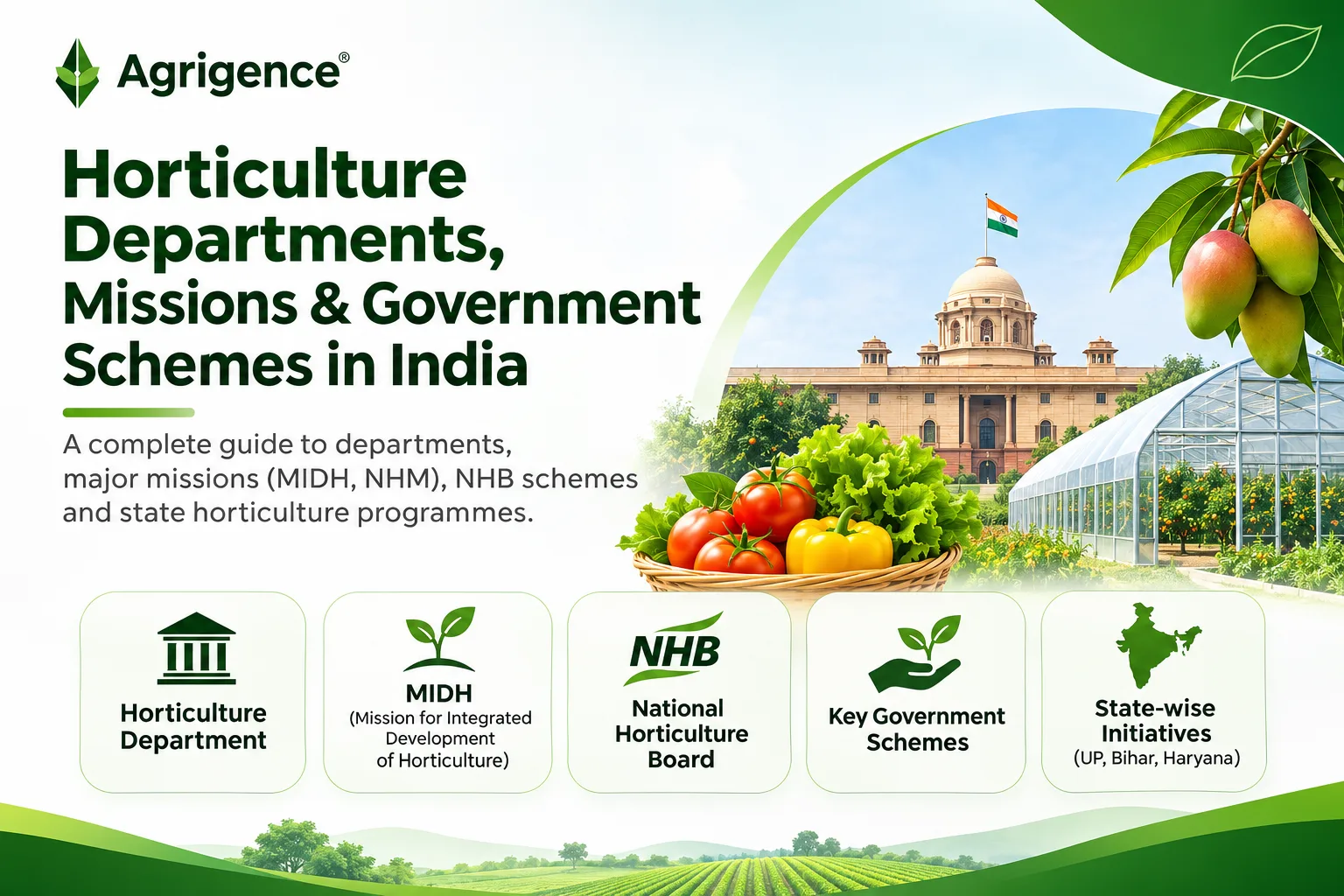
Horticulture is one of the important sectors of Indian agriculture, contributing to nutritional security, agricultural diversification, rural employment, farmers' income and the growth of agro-based industries.
India has diverse agro-climatic conditions that support the cultivation of numerous horticultural crops, including fruits, vegetables, flowers, spices, plantation crops, medicinal plants and aromatic plants.
However, the development of horticulture requires more than crop cultivation. Farmers need access to quality planting material, modern irrigation systems, protected cultivation technologies, financial assistance, post-harvest infrastructure, scientific guidance and organized marketing facilities.
To support these requirements, the Government of India and various state governments implement several horticulture development programmes and subsidy schemes.
The Department of Agriculture & Farmers Welfare, Ministry of Agriculture & Farmers Welfare, plays an important role in formulating and coordinating national horticulture development programmes. At the state level, horticulture departments, directorates and State Horticulture Missions implement different schemes and provide technical assistance to farmers.
Some major initiatives include:
- Mission for Integrated Development of Horticulture (MIDH)
- National Horticulture Mission (NHM)
- National Horticulture Board (NHB) schemes
- National Bamboo Mission (NBM)
- Horticulture Cluster Development Programme (HCDP)
- Clean Plant Programme (CPP)
- Per Drop More Crop (PDMC)
- State-specific horticulture development schemes
This article explains the organizational structure of horticulture departments in India, the major government missions, available financial assistance, and the procedure for accessing horticulture-related benefits.
1. What Is the Horticulture Department?
The Horticulture Department is a government administrative department responsible for promoting the production, productivity, development and commercialization of horticultural crops.
It works towards improving horticultural farming through scientific cultivation practices, technology transfer, infrastructure development, farmer training and implementation of government schemes.
The department generally covers:
- Fruit crop development and orchard establishment.
- Vegetable production and cultivation.
- Commercial floriculture.
- Protected cultivation through polyhouses and shade-net houses.
- Nursery development and quality planting material.
- Spices and plantation crop development.
- Medicinal and aromatic plant cultivation.
- Post-harvest management and cold-chain infrastructure.
- Micro-irrigation and water-use efficiency.
- Farmer training, extension and entrepreneurship development.
Major functions of the Horticulture Department
A. Development of horticultural crops
The department promotes the cultivation of fruits, vegetables, flowers, spices and other horticultural crops according to the agro-climatic conditions of different regions.
B. Financial assistance and subsidies
It facilitates financial assistance for eligible farmers and entrepreneurs for activities such as orchard establishment, protected cultivation, micro-irrigation, nurseries and post-harvest infrastructure.
C. Technical guidance
Horticulture officers provide technical guidance on crop selection, planting methods, plant spacing, pruning, training, irrigation, nutrient management, pest management and harvesting.
D. Nursery development
The department supports the establishment and improvement of nurseries to ensure the availability of quality planting materials.
E. Training and extension
Farmers receive scientific information through demonstrations, field visits, workshops, training programmes and agricultural exhibitions.
F. Post-harvest and marketing development
The department promotes facilities such as packhouses, grading units, cold storage, processing facilities and marketing infrastructure to minimize post-harvest losses.
2. Organizational Structure of Horticulture Departments in India
The implementation of horticulture development programmes involves coordination between the central government, state governments and district-level administrative authorities.
2.1 Central Government Level
At the national level, the Ministry of Agriculture & Farmers Welfare, through the Department of Agriculture & Farmers Welfare and its Horticulture Division, coordinates major horticulture development programmes.
Important institutions include:
- Department of Agriculture & Farmers Welfare
- Mission for Integrated Development of Horticulture (MIDH)
- National Horticulture Board (NHB)
- Coconut Development Board (CDB)
- National Bamboo Mission (NBM)
- Central Institute for Horticulture (CIH)
- Indian Council of Agricultural Research (ICAR)
2.2 State Government Level
Every state has a designated department, directorate, mission or authority responsible for horticulture development.
Depending on the state, it may operate under:
- Department of Horticulture
- Department of Agriculture
- Department of Agriculture and Farmers Welfare
- Department of Horticulture and Food Processing
These departments prepare implementation plans, identify priority crops, allocate scheme targets, coordinate with the central government and supervise subsidy programmes.
2.3 District Level
The District Horticulture Officer (DHO), Deputy Director Horticulture and other designated officials generally supervise horticulture activities at the district level.
Their responsibilities include:
- Registration of farmers.
- Receiving applications under horticulture schemes.
- Verification of land and project details.
- Technical inspection of proposed projects.
- Implementation and monitoring of approved schemes.
- Organization of training and awareness programmes.
- Verification of completed work before subsidy release.
The exact designation and administrative structure may differ between states.
3. Mission for Integrated Development of Horticulture (MIDH)
The Mission for Integrated Development of Horticulture (MIDH) is one of the most important national programmes for the development of India's horticulture sector.
It was launched in 2014–15 as a Centrally Sponsored Scheme to promote the comprehensive development of horticultural crops.
MIDH covers:
- Fruits
- Vegetables
- Root and tuber crops
- Mushrooms
- Spices
- Flowers
- Medicinal and aromatic plants
- Coconut
- Cashew
- Cocoa
- Bamboo
- Other horticultural crops
Objectives of MIDH
The main objectives include:
- Increasing the production and productivity of horticultural crops.
- Promoting crop diversification.
- Improving the availability of quality planting material.
- Encouraging modern horticultural technologies.
- Promoting protected cultivation and precision farming.
- Developing post-harvest management infrastructure.
- Reducing post-harvest losses.
- Improving farmers' income.
- Developing processing and marketing facilities.
- Generating rural employment and entrepreneurship opportunities.
Financial sharing pattern under MIDH
MIDH is a Centrally Sponsored Scheme, and its funding is shared between the central and state governments.
| Region / Implementing category | Central Government share | State Government share |
|---|---|---|
| General States | 60% | 40% |
| North-Eastern and Himalayan States | 90% | 10% |
| NHB, CDB, CIH, National Level Agencies and eligible UTs without legislature | 100% | 0% |
Important: These percentages represent the sharing of programme expenditure between governments. They are not the subsidy percentages automatically payable to individual farmers. Beneficiary assistance is determined separately for each intervention under the applicable operational guidelines.
Major components supported under MIDH
1. Production of planting material
- Establishment of horticultural nurseries.
- Hi-tech nurseries.
- Tissue culture facilities.
- Quality seed and planting-material production.
- Nursery infrastructure improvement.
2. Area expansion
- Establishment of new fruit orchards.
- Vegetable cultivation.
- Flower cultivation.
- Plantation crops.
- Spices.
- Medicinal and aromatic plants.
3. Rejuvenation of old orchards
Financial and technical support for the rejuvenation of old, senile and unproductive orchards using scientific management practices.
4. Protected cultivation
Support for modern structures and technologies, including:
- Naturally ventilated polyhouses.
- Fan and pad greenhouse systems.
- Shade-net houses.
- Plastic tunnels.
- Walk-in tunnels.
- Soilless cultivation systems.
5. Micro-irrigation and water management
Promoting efficient irrigation systems and water-management infrastructure for horticultural crops.
6. Integrated Nutrient Management and Integrated Pest Management
Encouraging balanced nutrient application, biofertilizers, plant-health management and scientific pest-control techniques.
7. Organic horticulture
Supporting organic production practices, certification and the development of horticultural value chains.
8. Post-harvest management
- Packhouses.
- Grading and sorting facilities.
- Cold storage.
- Refrigerated transportation.
- Processing and preservation infrastructure.
9. Mechanization
Promoting horticultural machinery and equipment to improve productivity and operational efficiency.
10. Training and human resource development
Developing technical capabilities among farmers, entrepreneurs, field workers and horticulture officers.
Important changes in MIDH Operational Guidelines 2025
The revised MIDH Operational Guidelines 2025 introduced several changes to strengthen horticultural development.
Important developments include:
- Coverage of all districts across the country.
- Revision of several horticultural cost norms.
- Inclusion of high-value, exotic and medicinal crops.
- Promotion of ultra-high-density plantations.
- Support for structures such as trellises and protective nets.
- Inclusion of soilless cultivation.
- Introduction of additional solar-based technologies for horticulture.
- Greater emphasis on modern production and post-harvest technologies.
These revisions are particularly relevant to farmers planning new orchards, protected cultivation projects and commercial horticulture enterprises.
Official source: Ministry of Agriculture & Farmers Welfare, MIDH Operational Guidelines 2025.
4. National Horticulture Mission (NHM)
The National Horticulture Mission (NHM) was launched in 2004–05 to promote the holistic development of the horticulture sector in India.
Its major objectives included increasing horticultural production, improving productivity, promoting quality planting material, supporting modern technologies and strengthening post-harvest management.
Major objectives of NHM
- Increase the area under horticultural crops.
- Improve the productivity and quality of horticultural produce.
- Promote commercial cultivation of fruits and vegetables.
- Improve nursery infrastructure.
- Encourage the use of improved varieties.
- Promote protected cultivation.
- Develop post-harvest infrastructure.
- Strengthen horticultural marketing and processing.
Is National Horticulture Mission still a separate scheme?
This is an important point for students and farmers.
The National Horticulture Mission was restructured and subsumed under the Mission for Integrated Development of Horticulture (MIDH) in 2014–15.
Therefore, NHM is now implemented as a sub-scheme within the broader MIDH framework.
Under the current structure:
- NHM covers states and Union Territories except the North-Eastern and Himalayan regions.
- HMNEH covers the North-Eastern and Himalayan regions.
- NBM covers bamboo development.
- NHB supports commercial horticulture and related infrastructure.
The restructuring and revised guidelines were also clarified by the Ministry of Agriculture & Farmers Welfare in its PIB release dated 10 February 2026.
Official source: Press Information Bureau – Restructuring of National Horticulture Mission.
5. National Horticulture Board (NHB)
The National Horticulture Board (NHB) was established in 1984 under the Government of India to promote the integrated development of the horticulture sector.
Its headquarters are located in Gurugram, Haryana.
NHB plays an important role in promoting commercial horticulture, post-harvest infrastructure, cold-chain facilities, technology transfer and horticultural marketing.
Major objectives of NHB
- Promote commercial horticultural production.
- Encourage high-value horticultural projects.
- Improve post-harvest management.
- Develop cold-storage infrastructure.
- Support modern horticultural technology.
- Promote quality planting material.
- Improve market information and technical services.
Major schemes of NHB
1. Development of Commercial Horticulture through Production and Post-Harvest Management
This programme supports eligible commercial horticultural projects involving production and related post-harvest infrastructure.
Examples include commercial fruit orchards and integrated horticultural production projects.
2. Capital Investment Subsidy Scheme for Cold Storage
This programme supports eligible projects for the construction, expansion or modernization of cold-storage and storage facilities for horticultural produce.
3. Technology Development and Transfer
Promotes the development and transfer of modern horticultural technologies to improve production and quality.
4. Market Information Scheme
Provides market-related information concerning horticultural crops.
5. Horticulture Promotion and Expert Services
Supports technical and expert services for horticulture development.
NHB online application and guidelines
Farmers, entrepreneurs and commercial project developers should check the latest operational guidelines, applicant eligibility, technical standards, cost norms and application procedures before submitting proposals.
The NHB website provides online application facilities and application-tracking services.
Official websites:
The NHB website lists amendments to its commercial horticulture and cold-storage scheme guidelines for 2026–27, including an amendment dated 21 August 2026. Applicants should therefore use the latest applicable version rather than relying on old subsidy charts.
6. National Bamboo Mission (NBM)
The National Bamboo Mission is an important initiative aimed at the development of the bamboo sector in India.
Bamboo has significant potential in agriculture, construction, handicrafts, furniture, industrial products and environmental applications.
The mission promotes the development of bamboo resources through:
- Bamboo nursery establishment.
- Quality planting material.
- Bamboo cultivation.
- Productivity improvement.
- Development of bamboo-based industries.
- Processing and value addition.
- Market development.
- Farmer and entrepreneur training.
NBM is included within the broader MIDH framework.
It provides opportunities for farmers, nursery operators, entrepreneurs and bamboo-based industries.
Official reference: MIDH Operational Guidelines 2025.
7. Clean Plant Programme (CPP)
The Clean Plant Programme (CPP) was approved by the Union Cabinet on 9 August 2024 with an investment of ₹1,765.67 crore.
The programme aims to improve the quality and productivity of horticultural crops by ensuring access to disease-free and virus-free planting material.
Major objectives
- Supply high-quality, disease-free planting material.
- Improve the productivity of fruit crops.
- Establish advanced diagnostic and tissue-culture facilities.
- Strengthen nursery certification systems.
- Promote region-specific varieties.
- Improve the quality of horticultural produce.
- Support India's horticultural export potential.
Clean Plant Centres
The programme provides for nine advanced Clean Plant Centres equipped with diagnostic, therapeutic and tissue-culture facilities.
Important crop groups include:
- Grapes.
- Temperate fruits such as apple, almond and walnut.
- Citrus fruits.
- Mango, guava and avocado.
- Mango, guava and litchi.
- Pomegranate.
- Tropical and subtropical fruits.
The programme is being implemented by the National Horticulture Board in association with ICAR.
It is particularly important for commercial orchards because the use of healthy planting material can help reduce the spread of important plant pathogens and improve orchard establishment.
Official source: PIB – Cabinet Approves Clean Plant Programme.
8. Horticulture Cluster Development Programme (HCDP)
The Horticulture Cluster Development Programme aims to improve the competitiveness of India's horticulture sector through cluster-based development.
Instead of focusing only on individual farm production, it encourages integrated development of selected horticultural crop clusters.
Major objectives
- Improve horticultural productivity.
- Strengthen quality planting material supply.
- Promote organized production clusters.
- Develop post-harvest and cold-chain infrastructure.
- Strengthen processing and value addition.
- Improve market access.
- Promote domestic and export-oriented horticultural supply chains.
A horticulture cluster may include farmers, Farmer Producer Organizations (FPOs), nurseries, processors, logistics providers, exporters and marketing agencies.
The programme helps connect different stakeholders across the horticultural value chain.
Official reference: National Horticulture Board.
9. Per Drop More Crop (PDMC) – Micro-Irrigation
The Per Drop More Crop programme is an important initiative under the Pradhan Mantri Krishi Sinchayee Yojana (PMKSY) framework.
It focuses on improving water-use efficiency through micro-irrigation technologies.
Major objectives
- Improve irrigation efficiency.
- Reduce water wastage.
- Promote efficient water application.
- Improve crop productivity.
- Encourage drip and sprinkler irrigation.
- Support water management in horticultural crops.
Technologies covered
Drip irrigation: Water is supplied directly near the plant root zone through a network of pipes and emitters.
Sprinkler irrigation: Water is applied through sprinklers in the form of droplets.
Micro-irrigation is particularly useful in fruit orchards, vegetable cultivation, spices and protected cultivation systems.
Farmers should check the current implementation arrangements, eligible equipment, approved suppliers and subsidy rates through their respective state departments.
Official reference: PMKSY Micro-Irrigation Portal.
10. Market Intervention Scheme (MIS) for Horticultural Crops
The Market Intervention Scheme is intended to support farmers growing agricultural and horticultural commodities that are perishable and are not covered under the Minimum Support Price regime.
It becomes particularly relevant when a bumper production season causes market prices to fall below the cost of production.
Main objectives
- Prevent distress sales.
- Support remunerative prices for farmers.
- Address unexpected market-price declines.
- Facilitate procurement and market intervention.
- Reduce losses associated with excess production.
In July 2026, the Government of India reported additional provisions for Price Differential Payment under the scheme.
The updated arrangements also include support for transportation and storage costs of Tomato, Onion and Potato (TOP) crops through designated agencies under specified conditions.
Payments under the Market Intervention Scheme are made directly into registered farmers' bank accounts under the applicable provisions.
Official source: PIB – Restructuring of National Horticulture Mission and Market Intervention Scheme.
11. Examples of Horticulture Subsidy and Cost Norms Under Revised MIDH Guidelines
Subsidy amounts depend on crop category, location, intervention, approved cost norms and the applicable guidelines.
The following examples were published by the Ministry of Agriculture & Farmers Welfare in its Lok Sabha reply dated 28 July 2026.
| Crop / Component | Revised cost norm | Reported assistance |
|---|---|---|
| Citrus – regular spacing | ₹1.25 lakh/ha | 40–50% depending on region |
| Citrus – high-density plantation | ₹2.00 lakh/ha | 40–50% depending on region |
| Citrus – ultra-high-density plantation | ₹3.00 lakh/ha | 40–50% depending on region |
| Seed spices, including cumin | ₹50,000/ha | As per applicable revised component norms |
| Medicinal and aromatic plants, including isabgol | ₹1.50 lakh/ha | 40–50% depending on region |
These are selected examples, not a complete subsidy schedule.
Important: A cost norm is the prescribed eligible benchmark used for calculating assistance. It does not necessarily represent the full cost of establishing a project or the amount of subsidy received by a farmer.
For the latest crop-wise assistance, applicants should refer to the revised MIDH Operational Guidelines and the relevant state government's approved annual action plan.
Source: Ministry of Agriculture & Farmers Welfare, Lok Sabha reply, 28 July 2026.
12. State Horticulture Departments and Government Schemes in India
Horticulture programmes are implemented through state governments, and the availability of schemes, crop priorities, financial assistance and application procedures may vary from one state to another.
Some states also provide additional financial assistance through their own horticulture development programmes.
The following are examples of state-level horticulture departments.
12.1 Uttar Pradesh Horticulture Department
The Department of Horticulture and Food Processing, Government of Uttar Pradesh, is responsible for promoting horticultural production, food processing and related development programmes in the state.
Important areas of intervention include:
- Fruit orchard development.
- Mango, guava, amla and banana cultivation.
- Vegetable production.
- Floriculture.
- Protected cultivation.
- Polyhouse and greenhouse development.
- Micro-irrigation.
- Nursery development.
- Horticultural mechanization.
- Post-harvest management.
The state also implements horticulture development interventions under MIDH through its designated administrative structure.
Online application and portals
1. Department of Horticulture and Food Processing, Uttar Pradesh
2. UP Micro-Irrigation Portal
Farmers can use the micro-irrigation portal for registration and applications under the relevant micro-irrigation programme.
The registration system includes district, tehsil, block, village, farmer details, land records, irrigation area and supplier information.
3. State Horticultural Export Promotion Board
This portal provides registration facilities for farmers, producers, FPOs and exporters.
12.2 Bihar Horticulture Department
The Directorate of Horticulture, Department of Agriculture, Government of Bihar, implements various programmes for horticultural development.
Bihar has considerable potential for fruit cultivation, vegetables, spices, mushrooms, makhana, flowers and other commercial horticultural crops.
The state's 2026–27 official scheme dashboard lists the following programmes:
| Scheme / Programme | Main purpose |
|---|---|
| PMKSY – Micro-Irrigation | Efficient irrigation |
| National Makhana Board | Makhana sector development |
| Mushroom-related schemes | Mushroom production |
| Post-Harvest Management | Storage and post-harvest facilities |
| Coconut Plant Distribution | Coconut planting material |
| Tea Development Scheme | Tea cultivation |
| Integrated Horticulture Development Mission | Horticulture development |
| Marigold Production and Processing | Floriculture and value addition |
| National Bamboo Mission | Bamboo development |
| Cluster Horticulture Scheme | Cluster-based crop development |
| Cluster Vegetable and Spice Scheme (PM-RKVY) | Vegetable and spice production |
| National Mission on Edible Oils – Oil Palm | Oil palm development |
| Seed Spice Scheme | Seed spice cultivation |
| Potato Area Expansion Scheme | Potato cultivation |
The Bihar horticulture department also provides an online application facility for its listed programmes.
Official portal: Directorate of Horticulture, Bihar
2026–27 scheme dashboard: View schemes and applications
12.3 Haryana Horticulture Department
The Department of Horticulture, Government of Haryana, promotes commercial horticulture, crop diversification, protected cultivation and horticultural entrepreneurship.
Major interventions include:
- Fruit cultivation.
- Vegetable production.
- Floriculture.
- Mushroom production.
- Protected cultivation.
- Micro-irrigation.
- Crop insurance.
- Honey and beekeeping.
- Horticulture clusters.
- Farmer training and skill development.
The department operates the Unified and Integrated Horticulture Networking (HORTNET) portal.
Haryana HORTNET portal
The portal provides facilities for:
- Farmer registration.
- Application submission.
- Document upload.
- Horticulture scheme applications.
- Application acknowledgement.
- Scheme guidelines and cost norms.
Official portal:
https://hortnet.hortharyana.gov.in/
Example: Haryana horticulture subsidy initiative in 2026
In a government announcement dated 28 September 2026, Haryana introduced substantial assistance for the cultivation of horticultural crops.
The announced assistance included:
| Crop category | Announced assistance |
|---|---|
| New fruit orchards | ₹24,500–₹1,40,000 per acre |
| Vegetables – General category | ₹15,000 per acre |
| Vegetables – Scheduled Caste category | ₹25,500 per acre |
| Spices | ₹15,000–₹30,000 per acre |
| Flowers | ₹8,000–₹40,000 per acre |
| Aromatic plants | ₹8,000 per acre |
Important eligibility conditions included:
- New fruit orchards and spice cultivation: maximum 5 acres.
- Vegetables: maximum 5 acres for general-category farmers and 1 acre for Scheduled Caste farmers.
- Flowers and aromatic crops: maximum 5 acres.
- Vegetable assistance requires integrated cultivation practices such as mulching, low tunnels, drip irrigation or bamboo staking.
Registration on both Meri Fasal-Mera Byora and HORTNET is mandatory under the announced programme. The state also specifies additional documentation, including Parivar Pehchan Patra and bank details.
These rates relate to the specified Haryana state initiative and should not be treated as national MIDH rates.
Official source: Haryana Government – Horticulture Subsidy Announcement, 28 September 2026.
13. How Can Farmers Apply for Horticulture Department Subsidies?
Farmers interested in establishing orchards, polyhouses, nurseries, vegetable units or other horticultural enterprises should follow the scheme-specific application process.
Step 1: Identify the suitable scheme
First, identify the activity for which financial assistance is required.
For example:
- Fruit orchard establishment – MIDH.
- Polyhouse construction – MIDH or applicable NHB programme.
- Cold storage – NHB scheme, subject to eligibility.
- Drip irrigation – PMKSY/PDMC through the relevant state.
- Bamboo cultivation – National Bamboo Mission.
- Clean planting material – relevant Clean Plant Programme facilities.
Step 2: Contact the District Horticulture Officer
Visit the district horticulture office to obtain information about:
- Available schemes.
- Current application dates.
- Eligible crops.
- Subsidy limits.
- Approved cost norms.
- Technical specifications.
- Documents required.
Step 3: Complete farmer registration
Register on the applicable state government portal.
Depending on the state and scheme, farmer registration may involve Aadhaar or other identification, mobile number, land records and bank information.
Step 4: Prepare the project proposal
For infrastructure and commercial projects, prepare a suitable project report.
A typical project proposal may include:
- Land details.
- Proposed crop and variety.
- Area of cultivation.
- Irrigation arrangement.
- Estimated project cost.
- Production technology.
- Infrastructure requirements.
- Expected production and marketing plan.
Some schemes require a detailed bankable project report.
Step 5: Submit the application
Submit the online or offline application with the prescribed documents.
Ensure that the selected activity, crop and project design meet the applicable guidelines.
Step 6: Departmental verification
The designated horticulture officials may inspect the proposed site and verify the applicant's details.
Approval will depend on scheme eligibility, technical requirements, available funds and the state's approved implementation plan.
Step 7: Project implementation
Undertake the approved work according to the prescribed guidelines.
Do not begin construction or purchase equipment before obtaining any required prior approval or sanction.
Step 8: Inspection and subsidy release
After implementation, the department or designated agency may conduct physical verification and examine the relevant bills, invoices and project documents.
Financial assistance is released through the prescribed payment mechanism, which may involve DBT or credit-linked, back-ended assistance depending on the scheme.
14. Documents Generally Required for Horticulture Schemes
Document requirements differ between states and schemes.
Commonly required documents include:
- Aadhaar card or other prescribed identity proof.
- Farmer registration details.
- Passport-size photograph.
- Land ownership records or accepted land-use documents.
- Bank passbook and account details.
- Mobile number.
- Caste certificate, where applicable.
- Project report, where required.
- Cost estimates and quotations.
- Invoices and completion documents, where applicable.
For infrastructure projects, additional documents such as bank loan sanction, technical drawings, layout plans and business registration may be required.
Applicants should always follow the latest official checklist.
15. Importance of Government Horticulture Schemes for Farmers
Government horticulture schemes play an important role in the modernization and commercialization of Indian agriculture.
15.1 Financial support
Subsidies help eligible farmers reduce the initial investment required for establishing horticultural enterprises.
15.2 Modern technology adoption
Farmers can adopt drip irrigation, fertigation, protected cultivation and improved planting materials.
15.3 Crop diversification
Horticulture provides opportunities to diversify from conventional field crops into fruits, vegetables, spices and flowers.
15.4 Improvement in productivity
Scientific crop management and improved varieties can increase productivity and product quality.
15.5 Post-harvest loss reduction
Storage, grading, packaging and cold-chain infrastructure help preserve the quality of perishable produce.
15.6 Rural entrepreneurship
Horticulture creates opportunities in nurseries, mushroom cultivation, processing, protected cultivation, marketing and agribusiness.
16. Important Precautions Before Applying for Horticulture Subsidies
Farmers should consider the following points before investing in any project:
- Verify the current scheme guidelines rather than relying on old subsidy information.
- Confirm the availability of funds and application targets in the concerned district.
- Check whether prior departmental approval is mandatory.
- Use quality planting material from eligible or accredited sources as prescribed.
- Follow the technical standards of approved structures and equipment.
- Confirm the beneficiary contribution and maximum eligible area.
- Keep all project bills, invoices and payment records.
- Verify the application status through official portals.
- Avoid unauthorized agents or individuals promising guaranteed subsidies.
A subsidy is subject to eligibility, technical compliance, approval and fund availability. Registration alone does not guarantee financial assistance.
17. Conclusion
The horticulture department plays a significant role in transforming India's horticultural sector through scientific cultivation, technology adoption, infrastructure development and farmer-oriented government programmes.
Initiatives such as the Mission for Integrated Development of Horticulture, National Horticulture Mission, National Horticulture Board schemes, National Bamboo Mission, Clean Plant Programme and state-level subsidy programmes provide institutional and financial support for horticultural development.
The development of horticulture requires coordinated efforts from the central government, state departments, agricultural universities, research institutions, farmers, FPOs and private-sector stakeholders.
For farmers, understanding the available government schemes is an important step towards establishing profitable and sustainable horticultural enterprises.
For agricultural students and researchers, knowledge of horticulture departments and government missions is equally important for understanding the institutional structure, policy framework and development priorities of Indian horticulture.
The future of Indian horticulture depends on scientific farming, quality planting material, efficient resource management, modern infrastructure and effective implementation of government development programmes.
Frequently Asked Questions (FAQs)
1. What is the Horticulture Department in India?
The Horticulture Department is a government body responsible for promoting fruit, vegetable, flower, spice, medicinal and other horticultural crops through technical guidance, development programmes and financial assistance.
2. What is the National Horticulture Mission (NHM)?
NHM was launched in 2004–05 to promote horticultural development in India. It was restructured and subsumed under MIDH in 2014–15.
3. What is MIDH in horticulture?
MIDH stands for Mission for Integrated Development of Horticulture. It is a Centrally Sponsored Scheme that supports horticultural production, protected cultivation, nurseries, post-harvest infrastructure and technology development.
4. What is NHB in horticulture?
NHB stands for National Horticulture Board. It promotes commercial horticulture, cold storage, post-harvest infrastructure, technology development and horticultural marketing.
5. What is the difference between NHM and MIDH?
NHM is a horticulture development mission launched in 2004–05 and subsequently subsumed under MIDH in 2014–15. MIDH is the broader programme covering several horticultural development components.
6. Which department provides horticulture subsidies in Uttar Pradesh?
The Department of Horticulture and Food Processing, Government of Uttar Pradesh, implements various horticulture development programmes and subsidy-related interventions.
7. How can farmers apply for horticulture subsidies in Bihar?
Farmers can visit the official Bihar Directorate of Horticulture portal, check the current scheme dashboard and submit applications through the available online application facility.
8. What is the HORTNET portal in Haryana?
HORTNET is the Unified and Integrated Horticulture Networking portal of Haryana. It provides farmer registration, scheme applications, document-upload facilities and other horticultural services.
9. What is the Clean Plant Programme?
The Clean Plant Programme is an initiative approved in August 2024 to improve access to high-quality, disease-free planting material and strengthen India's fruit-production system.
10. What is the purpose of Per Drop More Crop?
Per Drop More Crop promotes efficient water utilization through drip and sprinkler irrigation systems to improve agricultural water-use efficiency.
11. Can farmers receive subsidies for polyhouse construction?
Yes. Eligible farmers can receive financial assistance for protected cultivation structures under applicable MIDH and NHB programmes, subject to scheme norms, technical specifications and approval.
12. Is horticulture subsidy available to small and marginal farmers?
Yes. Small and marginal farmers may be eligible for different horticulture development interventions. The actual assistance depends on the scheme, crop, region, applicant category and applicable guidelines.