Published by: Agrigence
Category: Uttar Pradesh Agriculture | Agriculture News | Agronomy
Updated: 22 November 2026
Official Links & Direct Resources
Season: Rabi 2026–27
Primary data source: Department of Agriculture, Government of Uttar Pradesh
Latest review: 18 November 2026
1. Introduction
Uttar Pradesh is one of India's most important agricultural states, with a diverse cropping system dominated by wheat, rice, sugarcane, pulses, oilseeds and several horticultural crops.
The Rabi season plays a significant role in the state's agricultural economy. Wheat, mustard, gram, lentil, pea and barley are among the major crops cultivated during this period.
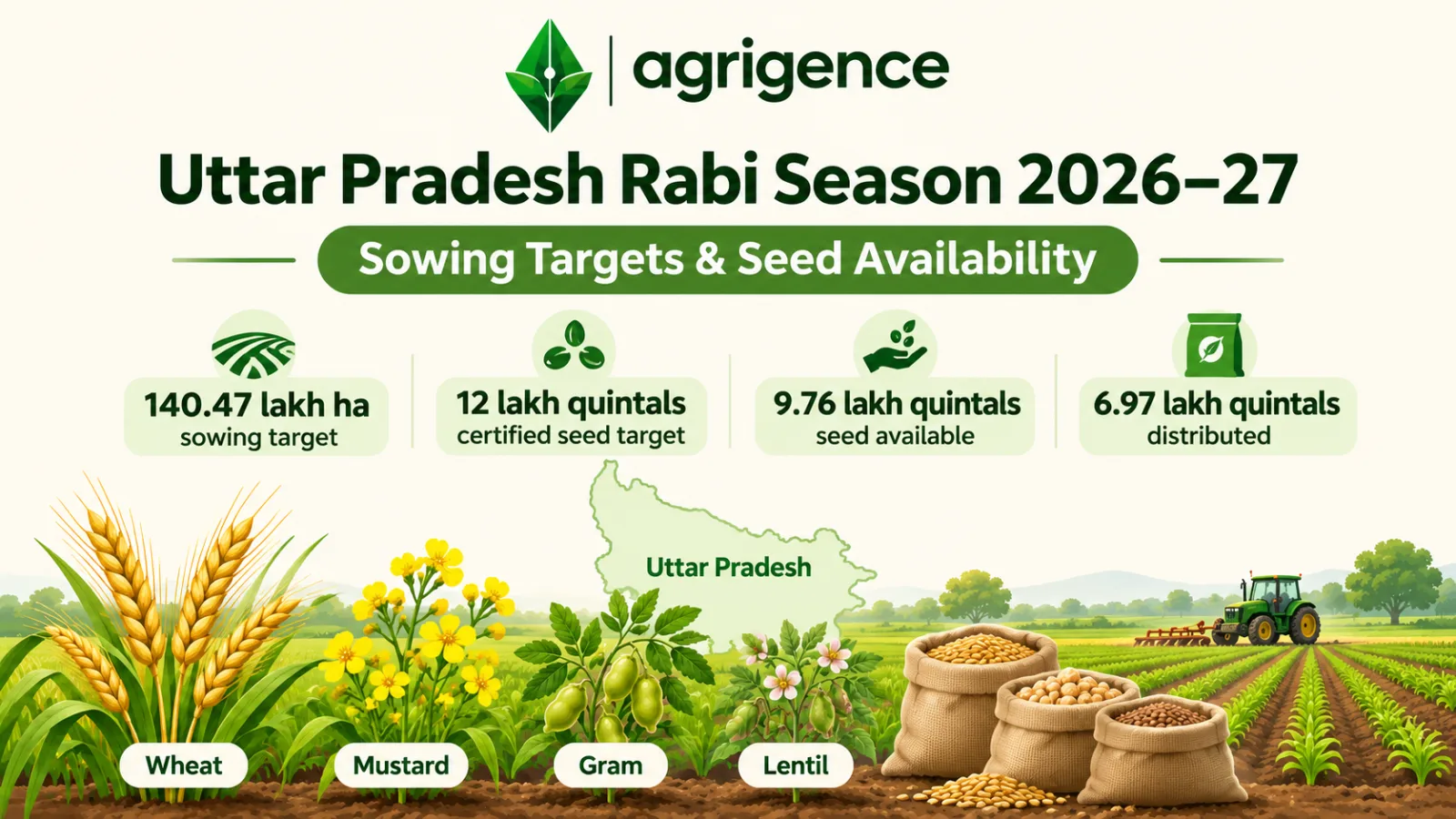
For the Rabi 2026–27 season, the Uttar Pradesh government has increased its total sowing target to 140.47 lakh hectares, compared with 139.17 lakh hectares in the previous year.
The state government is focusing on expanding the cultivation of pulses and oilseeds, improving the availability of certified seeds, strengthening fertiliser distribution and encouraging scientific crop management.
On 18 November 2026, Agriculture, Agricultural Education and Research Minister Surya Pratap Shahi conducted a departmental review meeting at Krishi Bhawan, Lucknow, to assess the progress of Rabi preparations, seed availability, fertiliser distribution and departmental schemes.
During the review, officials reported that 9,75,912 quintals of certified seeds had been made available against a distribution target of 12 lakh quintals. Fertiliser availability was reported at 50.51 lakh metric tonnes across the state.
The government also instructed agricultural officials to ensure timely delivery of quality agricultural inputs and take strict action against fertiliser hoarding, black marketing and overpricing.
2. Uttar Pradesh Rabi Sowing Target 2026–27
The Uttar Pradesh government has increased the overall Rabi sowing target for 2026–27.
| Particulars | Area |
|---|---|
| Rabi target 2025–26 | 139.17 lakh hectares |
| Rabi target 2026–27 | 140.47 lakh hectares |
| Additional targeted area | 1.30 lakh hectares |
| Approximate increase | 0.93% |
The increased target reflects the state's intention to expand agricultural coverage and strengthen crop diversification.
Major crops targeted for expansion
The state government has specifically emphasised expansion of the following crops:
- Rai and mustard
- Toria
- Gram (chickpea)
- Pea
- Lentil (masoor)
These crops are important for improving domestic pulse and oilseed production, diversifying cropping systems and supporting agricultural income.
Important statistical clarification: The 140.47 lakh hectare figure is the total Rabi area target for Uttar Pradesh. The 18 November departmental release identifies priority crops but does not provide a separate hectare-wise target for each crop.
3. Certified Seed Availability in Uttar Pradesh
Quality seed is a critical input in agricultural production. It influences germination, crop establishment, varietal purity and the potential productivity of cultivated crops.
For Rabi 2026–27, the Uttar Pradesh government has established a target of distributing 12 lakh quintals of certified seeds through government institutions.
According to the departmental review conducted on 18 November 2026, the following progress was reported:
Certified seed distribution status
| Particulars | Quantity |
|---|---|
| Total distribution target | 12,00,000 quintals |
| Certified seeds made available | 9,75,912 quintals |
| Seeds distributed to farmers | 6,96,895 quintals |
| Availability against target | 81% |
| Distribution against available seeds | 71% |
The figures indicate that approximately 2,24,088 quintals remained to be made available against the total seed target at the time of the review.
The government has instructed officials to ensure that the remaining certified seed requirements are addressed and that quality seeds reach farmers before the suitable sowing window.
Importance of certified seed distribution
The availability of certified seed supports:
- Improved seed germination and crop establishment.
- Maintenance of varietal identity and genetic purity.
- Reduction in seed-borne disease risks through appropriate certification standards.
- Improved crop uniformity.
- Better adoption of improved crop varieties.
- Increased potential for agricultural productivity.
4. Seed Replacement Rate Target Increased to 51%
The seed replacement rate (SRR) is an important indicator of the adoption of quality seeds in agriculture.
It represents the proportion of cultivated area planted with newly acquired quality seed rather than seed retained by farmers from previous harvests.
The Uttar Pradesh government aims to increase the average seed replacement rate from 49% to 51% during Rabi 2026–27.
| Particulars | Seed Replacement Rate |
|---|---|
| Previous target | 49% |
| New target | 51% |
| Increase | 2 percentage points |
Why is a higher seed replacement rate important?
- Encourages the adoption of improved varieties.
- Helps maintain varietal purity.
- Supports improved crop establishment.
- Encourages organised seed production and distribution.
- Strengthens the certified seed supply system.
The actual benefits depend on crop-specific seed replacement recommendations, varietal suitability and the quality of seed used.
5. Rabi Free Seed Mini-Kit Distribution Programme 2026–27
The Uttar Pradesh government is implementing a free seed mini-kit distribution programme to promote pulse and oilseed cultivation during the Rabi season.
The programme includes chickpea, pea, lentil, mustard and linseed.
According to the Agriculture Department notification dated 24 October 2026, the following crop-wise mini-kit allocations were announced:
Crop-wise free mini-kit allocation
| Crop | Number of mini-kits |
|---|---|
| Chickpea (Gram) | 84,506 |
| Field pea | 15,268 |
| Lentil (Masoor) | 1,09,700 |
| Rai/Mustard | 4,95,578 |
| Linseed (Alsi) | 30,000 |
These allocations were announced under the departmental programme for Rabi 2026–27.
Total mini-kit target and availability
The 18 November departmental review subsequently reported:
| Particulars | Number |
|---|---|
| Total distribution target | 7,66,057 |
| Mini-kits made available | 7,37,894 |
| Mini-kits distributed | 5,88,192 |
| Availability against target | 96% |
| Distribution against available mini-kits | 80% |
The government is using this programme to promote pulse and oilseed production and encourage farmers to diversify their cropping systems.
6. Subsidised Certified Seed Programme
Alongside free seed mini-kits, the Uttar Pradesh government is providing improved seed varieties under different subsidy arrangements.
According to the Agriculture Department's notification of 24 October 2026, the following assistance was announced:
| Crop | Subsidy |
|---|---|
| Lentil seed varieties less than eight years old | 100% |
| Chickpea seed | Up to 75% |
| Field pea seed | Up to 75% |
| Improved wheat varieties | Up to 50% |
| Improved barley varieties | Up to 50% |
| Improved rai/mustard varieties | Up to 50% |
These are scheme-specific subsidy rates, subject to the applicable programme conditions and availability.
The free mini-kit programme and subsidised improved-seed programme are separate benefits.
7. How to Apply for Free Rabi Seed Mini-Kits in Uttar Pradesh
Farmers can apply for the free seed mini-kit programme through the official Agriculture Department website.
Official application portal
https://agriculture.up.gov.in/
Application procedure
Step 1: Visit the official website
Open the Uttar Pradesh Agriculture Department's official portal.
Step 2: Complete Farmer Registration
Ensure that the farmer registration is completed and the registration number is available.
Step 3: Access the seed booking facility
Navigate to the relevant seed mini-kit or subsidised seed booking facility for Rabi 2026–27.
Step 4: Verify the farmer details
Enter the required Farmer Registration Number and verify the mobile number using the OTP received.
Step 5: Select the crop
Choose the required mini-kit or improved seed according to agricultural requirements and programme availability.
Available crops include:
- Chickpea
- Pea
- Lentil
- Rai/Mustard
- Linseed
Step 6: Complete the application
Submit the required information and complete the booking process.
Step 7: Follow the distribution instructions
Follow the instructions provided by the Agriculture Department regarding the collection and distribution of the selected seed.
Alternative application assistance
Farmers who need help with online booking can approach:
- Nearest Agriculture Department office.
- Government seed distribution centre.
- Common Service Centre (CSC).
- Regional Agriculture Department personnel.
Important: Bookings are accepted only up to the specified programme targets. Availability of a particular crop's mini-kit should be verified on the official portal before applying.
8. Fertiliser Availability in Uttar Pradesh for Rabi 2026–27
Adequate fertiliser availability is essential for maintaining crop productivity and ensuring timely sowing.
During the departmental review on 18 November 2026, the Uttar Pradesh government reported total fertiliser availability of 50.51 lakh metric tonnes.
Overall fertiliser availability
| Particulars | Quantity |
|---|---|
| Fertiliser availability on 18 November 2026 | 50.51 lakh MT |
| Availability during the same period last year | 42.40 lakh MT |
| Increase in availability | 8.11 lakh MT |
| November 2026 target | 32.70 lakh MT |
The reported fertiliser availability is approximately 19.13% higher than the corresponding period of the previous year.
The available quantity is also higher than the November monthly target.
Fertiliser stock after distribution
According to the departmental review, the following stocks remained available through cooperative and private distribution channels across all 75 districts.
| Fertiliser | Available stock |
|---|---|
| Urea | 20.03 lakh MT |
| DAP | 4.02 lakh MT |
| NPK | 5.49 lakh MT |
The government reported that sufficient fertiliser stocks were available in all 75 districts.
Importance of major fertilisers
Urea: An important source of nitrogen used to support vegetative growth, chlorophyll formation and protein synthesis.
DAP (Diammonium Phosphate): Supplies nitrogen and phosphorus, supporting early root development and crop establishment.
NPK fertilisers: Supply nitrogen, phosphorus and potassium in different formulations to meet crop-specific nutrient requirements.
Farmers should select fertilisers according to soil-test results and crop-specific recommendations rather than applying them solely on the basis of availability.
9. Action Against Fertiliser Hoarding and Overpricing
The Uttar Pradesh Agriculture Department has continued enforcement activities to prevent black marketing, fertiliser hoarding and sales above government-prescribed rates.
As reported during the 18 November review, the following enforcement actions had been taken:
| Enforcement activity | Reported action |
|---|---|
| Raids conducted | 7,364 |
| Fertiliser samples collected | 945 |
| Show-cause notices issued | 694 |
| Licences suspended | 136 |
| Licences cancelled | 35 |
| Shops sealed | 19 |
| FIRs registered | 30 |
| Illegal fertiliser stock seized | 266.60 MT |
These measures are intended to strengthen monitoring of agricultural input distribution and improve access to fertilisers at authorised prices.
Farmers should purchase fertilisers from authorised sellers and obtain purchase receipts.
10. Important Government Initiatives Supporting Rabi Agriculture
The departmental review also covered several initiatives related to agricultural development, irrigation and resource management.
10.1 Free electricity for private tubewells
The state government reported that the entire ₹1,800 crore subsidy allocation to Uttar Pradesh Power Corporation for free electricity supply to farmers' private tubewells had been paid.
This is relevant to the irrigation requirements of Rabi crops.
10.2 Scientific agriculture and climate-change management
The government reported complete budget utilisation under the following initiatives:
- Self-Reliant Farmer Integrated Development Scheme: ₹50 crore.
- Scientific Farming and Climate Change Impact Management: ₹10.60 crore.
- Seed Park Development Project: ₹8.54 crore.
These initiatives support agricultural development, improved production technologies and seed-sector infrastructure.
10.3 Farmer Registry
The Agriculture Department has appealed to farmers to complete 100% Farmer Registry according to their agricultural land details.
Farmers should ensure that their registration information is accurate and updated according to the applicable departmental requirements.
11. Major Rabi Crops in Uttar Pradesh and Their Production Importance
The Rabi cropping system in Uttar Pradesh includes cereals, pulses, oilseeds and other seasonal crops.
| Crop | Agricultural importance |
|---|---|
| Wheat | Major Rabi foodgrain crop |
| Barley | Cereal and feed crop |
| Gram | Important pulse and protein source |
| Lentil | Important winter pulse |
| Pea | Food and vegetable pulse crop |
| Mustard | Major edible oilseed |
| Toria | Short-duration oilseed crop |
| Linseed | Oilseed and industrial crop |
| Potato | Major commercial vegetable crop |
Crop diversification priorities
The government's focus on mustard, toria, gram, pea and lentil provides an opportunity to diversify farming systems.
Crop selection should be based on:
- Agro-climatic suitability.
- Soil type and fertility.
- Availability of irrigation.
- Quality seed availability.
- Market demand.
- Expected production costs and returns.
- Appropriate sowing period.
12. Scientific Recommendations for Farmers During Rabi 2026–27
Efficient agricultural production requires appropriate agronomic management throughout the crop cycle.
Soil testing and nutrient management
Farmers should conduct soil tests to determine nutrient status and follow balanced fertiliser recommendations.
Quality seed selection
Use certified and regionally recommended varieties suited to the local agro-climatic conditions.
Timely sowing
Follow the recommended sowing period for each crop to support good crop establishment and reduce exposure to unfavourable weather.
Seed treatment
Use crop-specific seed treatment measures according to the recommendations of ICAR institutes and State Agricultural Universities.
Irrigation planning
Schedule irrigation based on crop stage, soil moisture and available water resources.
Weed management
Monitor weeds during early crop growth and adopt recommended mechanical, cultural or chemical management measures.
Pest and disease monitoring
Regular field surveillance helps identify emerging pest and disease problems and supports timely integrated management.
13. Challenges and Opportunities for Uttar Pradesh Agriculture
Despite stronger input availability and increased sowing targets, several agricultural challenges remain.
Major challenges
- Uneven rainfall distribution and residual soil moisture.
- Availability of quality seed in remote farming areas.
- Timely distribution of mini-kits and subsidised seeds.
- Rising cultivation and labour costs.
- Efficient irrigation management.
- Fertiliser distribution and market transparency.
- Crop diversification at farm level.
- Climate variability and pest pressure.
Emerging opportunities
- Improved seed replacement rate.
- Expansion of pulse and oilseed cultivation.
- Development of seed parks.
- Scientific nutrient management.
- Digital farmer registration.
- Better agricultural extension services.
- Integrated farming systems.
- Improved irrigation infrastructure.
14. Conclusion
The Uttar Pradesh Rabi 2026–27 season is being supported through increased sowing targets, certified seed distribution, free seed mini-kits, fertiliser availability and agricultural development initiatives.
The government has established a Rabi sowing target of 140.47 lakh hectares and aims to increase the average seed replacement rate from 49% to 51%.
As of 18 November 2026, 9,75,912 quintals of certified seed had been made available against a target of 12 lakh quintals, while 6,96,895 quintals had been distributed to farmers.
The availability of 50.51 lakh metric tonnes of fertiliser and the distribution of 5,88,192 Rabi mini-kits demonstrate the progress reported during the departmental review.
The increased focus on mustard, toria, gram, pea and lentil also highlights the state's intention to strengthen pulse and oilseed production.
For the successful implementation of these initiatives, timely delivery of agricultural inputs, accurate farmer registration, scientific crop management and effective monitoring at the district level will remain essential.
The success of Rabi 2026–27 will depend not only on meeting the targeted cultivated area but also on improving crop productivity, seed quality, nutrient-use efficiency and farm profitability across Uttar Pradesh.
Frequently Asked Questions (FAQs)
1. What is the Uttar Pradesh Rabi sowing target for 2026–27?
The state has established a target of 140.47 lakh hectares, compared with 139.17 lakh hectares in the previous year.
2. How much certified seed is targeted for distribution during Rabi 2026–27?
The distribution target is 12 lakh quintals through government institutions.
3. How much certified seed was available as of 18 November 2026?
A total of 9,75,912 quintals had been made available.
4. How much seed had been distributed to farmers?
The department reported distribution of 6,96,895 quintals.
5. What is the target seed replacement rate?
The state aims to increase its average seed replacement rate from 49% to 51%.
6. Which crops are included in the free seed mini-kit programme?
Chickpea, pea, lentil, rai/mustard and linseed.
7. How many free seed mini-kits are targeted for distribution?
The programme target is 7,66,057 mini-kits.
8. What is the total fertiliser availability in Uttar Pradesh?
The state reported 50.51 lakh metric tonnes of fertiliser availability as of 18 November 2026.
9. What are the urea, DAP and NPK stocks after distribution?
The reported stocks are 20.03 lakh MT of urea, 4.02 lakh MT of DAP and 5.49 lakh MT of NPK.
10. How can farmers apply for free seed mini-kits?
Farmers can apply through the official Agriculture Department portal: https://agriculture.up.gov.in/
11. What subsidy is available on lentil seed?
The October 2026 departmental notification specifies a 100% subsidy on eligible lentil seed varieties less than eight years old under the relevant special pulse programme.
12. Where can farmers obtain assistance with online seed booking?
Farmers can approach the nearest Agriculture Department office, seed store, Common Service Centre or regional Agriculture Department personnel.
Official References
- Information and Public Relations Department, Government of Uttar Pradesh (18 November 2026). प्रदेश में रबी फसलों की बुवाई के लिए बीज और उर्वरकों का पर्याप्त स्टॉक उपलब्ध, कृषि मंत्री सूर्य प्रताप शाही ने कृषि भवन में की विभागीय समीक्षा.
- Information and Public Relations Department, Government of Uttar Pradesh (24 October 2026). निःशुल्क बीज मिनीकिट के लिए कृषि विभाग की आधिकारिक वेबसाइट पर करें आवेदन.
- Uttar Pradesh Agriculture Department: https://agriculture.up.gov.in/
- Uttar Pradesh Information Department: https://information.up.gov.in/
Data note: Figures presented in this article are based on the government departmental reviews dated 18 November 2026 and 24 October 2026. Seed and fertiliser availability figures are time-specific and may change as distribution continues. Crop-wise individual area targets have not been inferred where they were not specified in the cited government releases.
Agrigence | Learn • Grow • Prosper