Published by: Agrigence
Category: Soil Science | Agricultural Research | Government Initiatives
Campaign: Khet Bachao Abhiyaan – Rabi 2026
Campaign period: 22 October to 30 November 2026
Theme: Swasth Dhara, Samriddh Kisan (Healthy Soil, Prosperous Farmer)
Data source: Ministry of Agriculture and Farmers Welfare, Government of India
1. Introduction
Soil is the fundamental resource supporting agricultural production. Its physical, chemical and biological properties directly influence crop growth, nutrient availability, water retention and long-term agricultural productivity.
The continuous cultivation of agricultural land, imbalanced fertiliser application, declining soil organic matter, improper crop residue management and inefficient resource utilisation can adversely affect soil quality.
Recognising the importance of soil conservation and balanced nutrient management, the Government of India is implementing Khet Bachao Abhiyaan – Rabi 2026, a nationwide campaign focused on soil health, sustainable agriculture and scientific farming practices.
The campaign is organised under the Ministry of Agriculture and Farmers Welfare and runs from 22 October to 30 November 2026.
Its central message is to protect agricultural land through balanced fertiliser use, soil-test-based nutrient management, natural farming, crop diversification and the adoption of environmentally sustainable agricultural practices.
The campaign follows a convergence-based approach involving agricultural departments, the Indian Council of Agricultural Research (ICAR), Agricultural Universities, Krishi Vigyan Kendras (KVKs), Agricultural Technology Management Agencies (ATMA) and farming communities.
According to the Ministry's backgrounder released on 2 November 2026, the initiative covers 34 States and Union Territories, more than 700 districts and approximately 50,000 villages, with a target of reaching around 50 lakh farmers.
The campaign also envisages 50,000 field demonstrations and 11,750 structured training sessions.
The initiative carries the message that agricultural productivity should be improved not simply through greater application of external inputs, but through scientific nutrient management and the restoration of soil health.
2. What Is Khet Bachao Abhiyaan 2026?
Khet Bachao Abhiyaan is a nationwide agricultural awareness and extension initiative designed to encourage farmers to protect agricultural soil and adopt sustainable production systems.
The campaign promotes scientific approaches to fertiliser application, organic matter management, crop diversification, water conservation and environmentally responsible farming.
The Rabi 2026 edition is being implemented through field-level awareness programmes, farmer-scientist interactions, demonstrations and training sessions.
Basic campaign details
| Particulars | Details |
|---|---|
| Campaign name | Khet Bachao Abhiyaan – Rabi 2026 |
| Implementing ministry | Ministry of Agriculture and Farmers Welfare |
| Launch date | 22 October 2026 |
| Campaign closing date | 30 November 2026 |
| National theme | Swasth Dhara, Samriddh Kisan |
| States and UTs | 34 |
| District coverage | More than 700 |
| Village coverage | 50,000 |
| Target beneficiaries | Approximately 50 lakh farmers |
| Implementing network | KVKs, ATMA and agricultural institutions |
| Main focus | Soil health and balanced fertilisation |
The campaign is intended to take agricultural research and scientific recommendations directly to farmers through the Lab-to-Land approach.
Important: The 50,000 demonstrations, 11,750 training sessions and farmer coverage figures are campaign targets or planned outreach figures, not necessarily completed achievements as of the publication date.
3. Why Was Khet Bachao Abhiyaan Introduced?
Indian agriculture faces several soil and nutrient management challenges.
Although fertilisers are essential for maintaining crop productivity, excessive dependence on selected nutrients without considering soil requirements can lead to nutrient imbalances.
3.1 Imbalanced fertiliser application
Farmers sometimes apply similar fertiliser quantities across different fields without considering differences in soil fertility, crop requirements and nutrient availability.
For example, excessive nitrogen application without adequate phosphorus, potassium, sulphur or micronutrients may result in unbalanced plant nutrition.
The campaign therefore promotes fertiliser recommendations based on soil testing and crop-specific nutrient requirements.
3.2 Declining soil organic matter
Soil organic matter supports important soil processes, including aggregation, water retention, nutrient cycling and microbial activity.
Continuous removal of crop residues, limited organic inputs and intensive cultivation can contribute to declining soil organic matter in some production systems.
The campaign promotes organic resource recycling, green manuring, composting and sustainable crop residue management.
3.3 Increasing cultivation costs
Unnecessary agricultural inputs can increase the cost of cultivation without generating proportional productivity improvements.
Scientific nutrient management can help farmers use fertilisers more efficiently and avoid unnecessary input expenditure.
3.4 Soil biological degradation
Soil contains microorganisms, fungi, bacteria, earthworms and other organisms that contribute to nutrient cycling and the maintenance of soil structure.
Indiscriminate chemical use and crop residue burning can negatively affect beneficial soil organisms.
The campaign highlights the importance of protecting soil biological activity.
3.5 Degradation of natural resources
Inefficient irrigation, soil erosion, nutrient losses and unsuitable land-management practices can threaten long-term agricultural sustainability.
Consequently, the campaign also promotes water conservation, regenerative practices and climate-resilient agriculture.
4. Major Targets and Implementation Scale
The Rabi 2026 campaign has been designed to achieve large-scale farmer engagement through agricultural extension networks.
National campaign targets
| Indicator | Target |
|---|---|
| States and Union Territories | 34 |
| Districts | 700+ |
| Villages | 50,000 |
| Farmers targeted | 50 lakh |
| Implementation teams | 4,150 |
| Scientists and ATMA functionaries | 12,000+ |
| Field demonstrations | 50,000 |
| Structured training sessions | 11,750 |
| Social media outreach | 1.5 crore farmers |
| Overall digital outreach envisaged | 2.5 crore |
The government has also identified 100 high fertiliser-consuming districts for priority intervention.
The campaign aims to encourage better fertiliser management in these districts through awareness, field demonstrations and scientific recommendations.
The implementation model brings together agricultural scientists, extension officers, farmers and local agricultural institutions.
5. Balanced Nutrient Management: The Central Pillar
Balanced nutrient management is one of the most important components of Khet Bachao Abhiyaan.
Plants require several essential nutrients for their growth and development. The availability of these nutrients depends on soil properties, crop requirements, fertiliser inputs, organic matter and environmental conditions.
5.1 Primary macronutrients
The three primary macronutrients are nitrogen, phosphorus and potassium.
Nitrogen (N)
Nitrogen is required for amino acid, protein and chlorophyll synthesis. It plays an important role in vegetative growth and photosynthetic activity.
Common nitrogen fertilisers include urea and other nitrogenous formulations.
Phosphorus (P)
Phosphorus is involved in energy transfer, nucleic acid synthesis, root development and reproductive growth.
Diammonium phosphate (DAP), single superphosphate (SSP) and other phosphate fertilisers are important sources.
Potassium (K)
Potassium supports enzyme activation, water regulation, stomatal functioning, carbohydrate transport and stress tolerance.
Muriate of potash (MOP) is a commonly used potassium fertiliser.
5.2 Secondary nutrients
Important secondary nutrients include:
- Calcium (Ca)
- Magnesium (Mg)
- Sulphur (S)
Sulphur is particularly important in oilseed production because of its role in amino acid and oil synthesis.
5.3 Micronutrients
Micronutrients are required in smaller quantities but perform essential physiological functions.
Important micronutrients include:
- Zinc (Zn)
- Iron (Fe)
- Manganese (Mn)
- Copper (Cu)
- Boron (B)
- Molybdenum (Mo)
- Chlorine (Cl)
- Nickel (Ni)
Micronutrient deficiencies can affect growth, flowering, fruit development and crop productivity.
The campaign encourages farmers to consider micronutrient requirements alongside the primary fertiliser nutrients.
6. The 4R Principle of Fertiliser Management
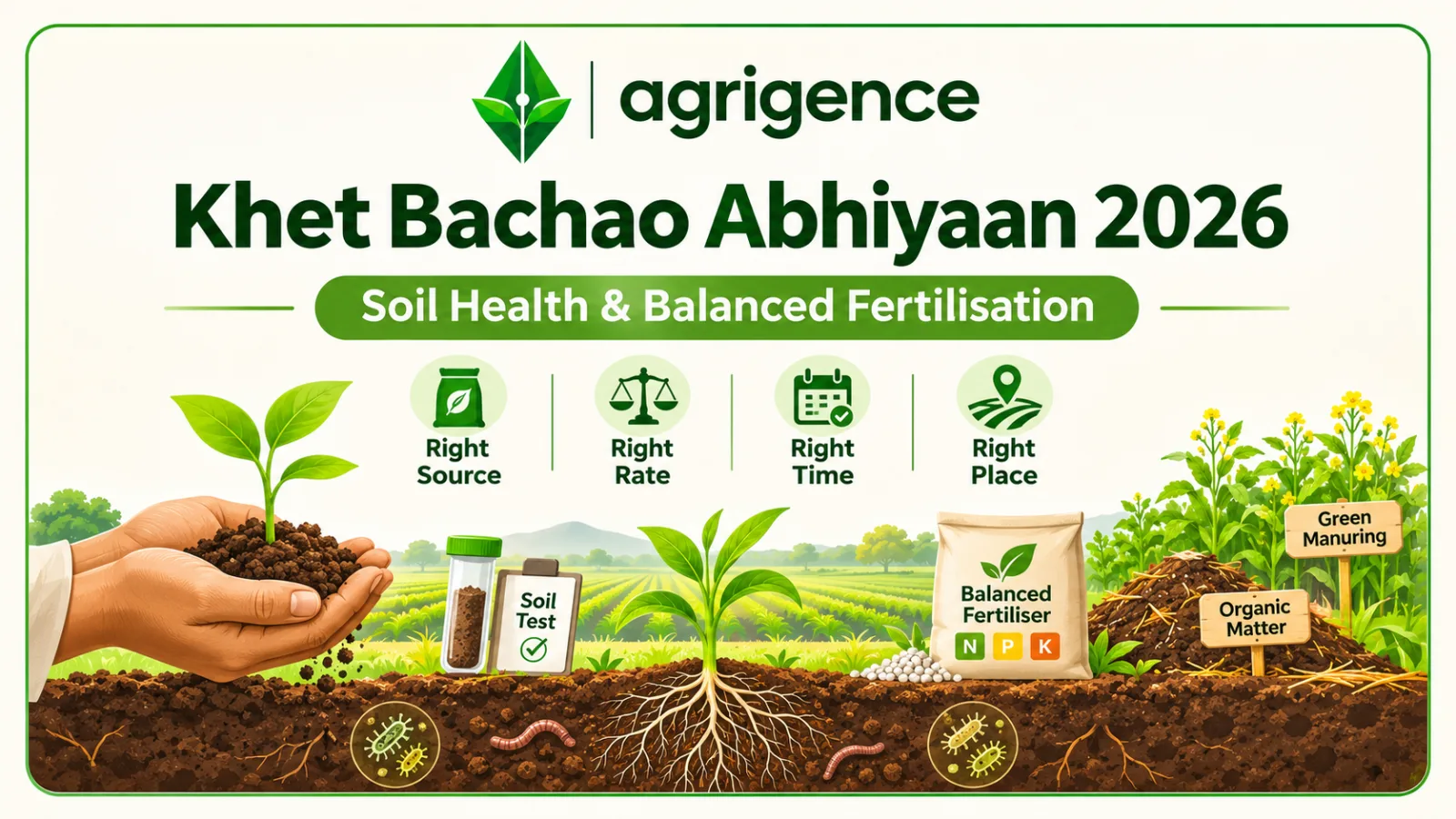
One of the most important technical concepts promoted under Khet Bachao Abhiyaan is the 4R Nutrient Stewardship framework.
The four principles are:
- Right Source
- Right Rate
- Right Time
- Right Place
The objective is to improve nutrient-use efficiency and reduce unnecessary fertiliser losses.
6.1 Right Source
Select the nutrient source according to soil characteristics, crop requirements and nutrient availability.
For example, the choice between urea, DAP, SSP and complex fertilisers should be based on the required nutrients and the relevant agronomic recommendation.
6.2 Right Rate
Apply nutrients at the recommended rate according to crop requirements and soil-test results.
Excessive fertiliser application can increase production costs and create nutrient imbalances.
The recommended quantity should be determined for the specific crop, soil and production system rather than following a generalised fertiliser schedule.
6.3 Right Time
Apply fertilisers according to the crop's nutrient demand and growth stage.
For example, nitrogen application in wheat is generally scheduled according to locally recommended crop-management practices and important growth stages.
The timing of application also influences nutrient uptake and potential losses.
6.4 Right Place
Place fertilisers where crop roots can access the nutrients efficiently.
Appropriate placement can improve nutrient-use efficiency and reduce avoidable losses.
The correct placement method depends on fertiliser type, crop, soil and irrigation system.
7. Soil Health Card and Soil-Test-Based Fertilisation
Soil testing is one of the most important starting points for sustainable nutrient management.
The Soil Health Card programme provides farmers with information about the nutrient status of their agricultural land and recommendations for fertiliser application and necessary soil amendments.
The Soil Health Card assesses 12 soil parameters.
Soil Health Card: 12 parameters
| Category | Parameter |
|---|---|
| Primary macronutrients | Nitrogen (N) |
| Primary macronutrients | Phosphorus (P) |
| Primary macronutrients | Potassium (K) |
| Secondary nutrients | Sulphur (S) |
| Micronutrients | Zinc (Zn) |
| Micronutrients | Iron (Fe) |
| Micronutrients | Copper (Cu) |
| Micronutrients | Manganese (Mn) |
| Micronutrients | Boron (B) |
| Soil chemical property | pH |
| Soil chemical property | Electrical Conductivity (EC) |
| Soil organic matter indicator | Organic Carbon (OC) |
How farmers should use soil-test information
- Collect representative soil samples from the agricultural field.
- Submit the samples to an authorised soil testing laboratory.
- Obtain the soil analysis report or Soil Health Card.
- Identify nutrient deficiencies and excesses.
- Follow crop-specific fertiliser recommendations.
- Apply suitable soil amendments where recommended.
- Monitor crop performance and periodically repeat soil testing.
Why is soil testing important?
Soil testing can help farmers:
- Identify nutrient deficiencies.
- Avoid unnecessary fertiliser application.
- Improve nutrient-use efficiency.
- Identify soil acidity or alkalinity issues.
- Assess soil organic carbon.
- Select appropriate soil amendments.
- Improve long-term soil management.
Farmers should use laboratory-approved soil sampling methods to ensure representative results.
8. Integrated Nutrient Management (INM)
Integrated Nutrient Management is an approach that combines different sources of plant nutrients to maintain soil fertility and support sustainable crop production.
The approach integrates mineral fertilisers with suitable organic and biological nutrient sources.
Major components of INM
1. Chemical fertilisers
Chemical fertilisers provide nutrients in forms that can be readily available to plants.
Their application should be based on soil-test results and recommended crop nutrient requirements.
2. Farmyard manure (FYM)
Well-decomposed farmyard manure contributes organic matter and nutrients while supporting soil physical and biological properties.
3. Compost
Composting converts biodegradable organic material into a more stable soil amendment.
It can support organic matter replenishment and nutrient recycling.
4. Vermicompost
Vermicomposting uses earthworms and associated microorganisms to process organic residues into a nutrient-containing organic amendment.
5. Biofertilisers
Biofertilisers contain beneficial microorganisms that support processes such as biological nitrogen fixation, phosphorus solubilisation and nutrient mobilisation.
Examples include:
- Rhizobium
- Azotobacter
- Azospirillum
- Phosphate-solubilising microorganisms
- Potassium-solubilising microorganisms
- Mycorrhizal fungi
6. Green manuring
Green manuring involves growing suitable crops and incorporating their biomass into the soil.
Examples include Dhaincha (Sesbania) and sunn hemp (Crotalaria juncea).
7. Crop residue recycling
Crop residues can be managed through appropriate incorporation, mulching, composting or other approved utilisation practices.
The selection of an INM strategy should consider crop type, soil conditions, organic resource availability and local research recommendations.
9. Green Manuring: An Important Strategy for Soil Restoration
Green manuring is an agricultural practice in which selected crops are grown to improve soil organic matter and nutrient cycling.
Leguminous green manure crops are particularly useful because they can fix atmospheric nitrogen through symbiotic associations with compatible rhizobia.
Important green manure crops
| Crop | Scientific name |
|---|---|
| Dhaincha | Sesbania spp. |
| Sunn hemp | Crotalaria juncea |
| Green gram | Vigna radiata |
| Cowpea | Vigna unguiculata |
Benefits of green manuring
- Adds organic biomass to the soil.
- Contributes to soil organic matter.
- Supports biological nitrogen fixation in suitable legumes.
- Improves soil aggregation.
- Supports beneficial soil microorganisms.
- Can improve nutrient cycling.
- Helps diversify crop rotations.
Scientific example highlighted under the campaign
A PIB report on the Raxaul outreach programme in East Champaran, Bihar, highlighted the following potential nitrogen contributions:
| Green manure crop | Reported nitrogen contribution | Approximate urea equivalent cited |
|---|---|---|
| Dhaincha (Sesbania spp.) | 50–60 kg N/ha | 110–130 kg/ha |
| Summer green gram | 25–30 kg N/ha | 55–65 kg/ha |
These are illustrative contributions reported in the campaign example, not universal nutrient credits for every field.
Actual nitrogen contribution depends on biomass production, crop growth, inoculation, soil conditions and biomass incorporation or decomposition.
Farmers should use local agronomic recommendations when adjusting fertiliser application.
10. Natural Farming and Soil Health
Natural farming is another important component of Khet Bachao Abhiyaan.
The campaign encourages awareness, training, demonstrations and farmer-to-farmer knowledge sharing.
Its focus is on locally available resources, biological inputs, reduced dependence on external agricultural inputs and sustainable farm management.
Important natural farming practices
- Beejamrit for seed treatment where recommended.
- Jeevamrit and Ghanjeevamrit as traditional biological preparations.
- Organic residue recycling.
- Crop diversification.
- Mulching.
- Improved soil biological activity.
- Water conservation.
The campaign's launch programme also encouraged farmers to begin natural farming on a limited portion of their land rather than making an immediate whole-farm transition.
Natural farming methods should be evaluated according to local soil, crops, resource availability and production conditions.
Farmers should monitor nutrient supply and crop performance during any transition.
11. Crop Residue Management: Preventing Soil Degradation
Crop residue management is an important component of the campaign, particularly in Punjab, Haryana, Uttar Pradesh and Madhya Pradesh.
The campaign aims to discourage the burning of agricultural residues and promote sustainable alternatives.
Why should crop residue burning be avoided?
Crop residue burning can:
- Contribute to air pollution.
- Destroy surface soil organisms.
- Reduce the availability of organic residues for soil management.
- Affect beneficial insects and earthworms.
- Cause the loss of some plant nutrients.
- Create fire-related risks.
Alternative crop residue management practices
Residue incorporation
Suitable residues can be incorporated into the soil using appropriate machinery and agronomic practices.
Mulching
Crop residues can be retained on the soil surface as mulch to help conserve moisture and reduce weed emergence.
Composting
Residues can be processed into compost and subsequently utilised as an organic soil amendment.
Vermicomposting
Suitable organic residues can be converted into vermicompost using earthworms.
Utilisation as livestock feed
Certain crop residues can be processed and utilised as animal feed where appropriate.
The correct residue management practice depends on the crop, residue characteristics, available machinery and the next crop's sowing requirements.
12. Crop Diversification and Rice-Fallow Management
The campaign also promotes diversification of agricultural production systems.
Continuous cultivation of the same crop sequence can create challenges related to nutrient removal, pest pressure, weed management and resource use.
The inclusion of pulses and oilseeds can improve cropping-system diversity.
Major recommended diversification opportunities
- Rice–wheat systems incorporating pulses.
- Rice-fallow systems using suitable short-duration crops.
- Mustard cultivation in appropriate regions.
- Chickpea and lentil cultivation.
- Inclusion of green gram in suitable cropping sequences.
Role of pulse crops
Pulses can contribute to agricultural sustainability through biological nitrogen fixation when suitable varieties and compatible rhizobial associations are present.
The incorporation of pulse residues can further contribute to organic matter and nutrient cycling.
However, crop diversification must be planned according to irrigation availability, crop duration, soil characteristics and local market demand.
13. Climate-Resilient Agriculture and Water Conservation
Climate variability is an important concern in agricultural production.
The campaign promotes location-specific contingency planning and improved natural-resource management.
Key practices
- Water-efficient irrigation.
- Rainwater harvesting.
- Soil moisture conservation.
- Mulching.
- Crop diversification.
- Suitable crop and variety selection.
- Improved nutrient-use efficiency.
- Sustainable land management.
The campaign's official backgrounder particularly identifies drought-affected areas in Maharashtra, Karnataka, Telangana, Andhra Pradesh and Rajasthan for location-specific contingency planning.
The objective is to improve agricultural resilience by adjusting crop and resource-management strategies to local climatic conditions.
14. Integrated Pest Management and Pesticide Stewardship
Soil health and plant protection are interconnected aspects of sustainable agriculture.
The campaign promotes Integrated Pest Management (IPM), pesticide quality awareness and responsible pesticide use.
Major IPM components
- Regular field monitoring.
- Correct pest identification.
- Cultural and mechanical management.
- Biological control.
- Use of resistant varieties where available.
- Need-based chemical control.
- Label-compliant pesticide application.
- Pesticide safety and stewardship.
The campaign discourages indiscriminate pesticide use and promotes the adoption of science-based plant-protection recommendations.
15. Institutional Roles and Responsibilities
The campaign follows a coordinated implementation approach involving national, state, district and village-level institutions.
| Institution | Major responsibility |
|---|---|
| State Agriculture Departments | Campaign planning and implementation |
| ATMA | District, block and village-level coordination |
| District Agriculture Administration | Farmer mobilisation and local execution |
| ICAR Institutes | Scientific guidance and research support |
| Agricultural Universities | Technical recommendations and training |
| KVKs | Farmer demonstrations and field-level extension |
| FPOs | Farmer mobilisation and peer learning |
| SHGs | Community engagement |
| PACS | Local institutional support |
| Custom Hiring Centres | Access to appropriate farm machinery |
| Progressive Farmers | Experience sharing and demonstration support |
The Ministry's backgrounder clarifies that ICAR institutions, KVKs and agricultural universities primarily provide scientific and technical support, whereas state departments and district administrations lead administrative implementation.
This institutional convergence is intended to improve the transfer of agricultural technologies from laboratories and research institutions to farmers' fields.
16. Campaign Activities and Farmer Training
Farmer participation and practical learning are important components of the campaign.
The government envisages:
- 50,000 agricultural field demonstrations.
- 11,750 structured training sessions.
- 4,150 campaign teams involving KVKs and ATMA.
- More than 12,000 scientists and ATMA functionaries supporting implementation.
Training themes include:
- Integrated Nutrient Management.
- Crop Residue Management.
- Natural Farming.
- Green Manuring.
- Improved Pulse and Oilseed Production.
- Integrated Pest Management.
- Balanced Fertiliser Application.
- Soil Health Management.
The campaign also encourages direct farmer-scientist interactions through village-level programmes.
An example of field-level implementation
On 23 October 2026, ICAR-Mahatma Gandhi Integrated Farming Research Institute, Motihari, in collaboration with KVK Piprakothi, organised a training programme under Khet Bachao Abhiyaan – Rabi 2026.
The programme covered soil-test-based nutrient recommendations, balanced fertiliser application, Integrated Nutrient Management and the use of biological inputs.
Scientists also discussed GreenSeeker-based crop sensing technology for improved nitrogen management and the inclusion of mung bean in rice-based cropping systems.
The programme involved 28 farmers and trainees.
This illustrates the campaign's emphasis on practical, science-based agricultural extension.
17. Previous Khet Bachao Abhiyaan: June 2026
The Rabi 2026 edition builds on a previous nationwide Khet Bachao Abhiyaan conducted from 1 to 30 June 2026.
The June campaign focused on soil health, balanced fertiliser use and sustainable agricultural practices.
According to the Ministry's 2 November backgrounder, the earlier phase achieved:
| Activity | Reported achievement |
|---|---|
| Multidisciplinary teams | 1,657 |
| Awareness events | More than 1.34 lakh |
| Farmers reached through awareness events | 92.44 lakh |
| Training sessions on green manuring and biofertilisers | 6,685 |
| Farmers benefiting from those training sessions | 4.94 lakh |
| Field demonstrations | 3,167 |
| Interactive programmes | 4,779 |
| Janpratinidhi Sammelans | 4,916 |
| Overall direct reach | Approximately 1.07 crore farmers and stakeholders |
| Social media outreach | Approximately 4.5 crore citizens |
These are achievements reported for the June campaign. They should not be confused with the targets established for the October–November Rabi edition.
The experience from the earlier campaign provides a foundation for continued farmer engagement and field-level extension.
18. Practical Soil Health Management Checklist for Farmers
Farmers can use the following checklist to improve their farm nutrient-management practices.
| Activity | Recommended action |
|---|---|
| Soil testing | Obtain periodic soil analysis |
| Soil Health Card | Review field-specific nutrient recommendations |
| Fertiliser selection | Choose suitable nutrient sources |
| Fertiliser dosage | Follow crop- and soil-specific recommendations |
| Application timing | Apply nutrients at suitable crop stages |
| Fertiliser placement | Follow recommended placement methods |
| Organic matter | Use suitable organic amendments |
| Green manuring | Include appropriate green manure crops |
| Biofertilisers | Use suitable, quality-assured products |
| Crop residues | Avoid indiscriminate burning |
| Crop rotation | Include suitable pulse crops |
| Irrigation | Manage water according to crop needs |
| Pest management | Follow integrated pest management |
| Monitoring | Assess crop and soil response |
19. Challenges in Implementing Balanced Fertilisation
Although the campaign offers a structured approach to improving soil health, several field-level challenges may influence its implementation.
Limited awareness of soil-test results
Some farmers obtain soil tests but may not fully understand nutrient recommendations.
Availability of organic inputs
The availability of well-decomposed manure, compost and other suitable organic materials may vary between agricultural regions.
Fertiliser purchasing behaviour
Established fertiliser purchasing habits can make the adoption of balanced nutrient management difficult.
Access to soil testing facilities
Farmers in remote areas may face challenges in accessing laboratories and obtaining timely analytical reports.
Residue management machinery
Small and marginal farmers may have limited access to machinery for crop residue management.
Regional differences in soil fertility
Different regions have different soil types, nutrient deficiencies and cropping systems. Therefore, uniform fertiliser recommendations are not appropriate for every farm.
These challenges highlight the importance of local agricultural extension services and field demonstrations.
20. Future Outlook: Towards Sustainable and Regenerative Agriculture
Khet Bachao Abhiyaan represents an important effort to increase the focus on soil health as a foundation for sustainable agricultural development.
The initiative brings attention to several areas that will remain relevant to Indian agriculture:
- Soil-test-based nutrient management.
- Integrated Nutrient Management.
- Organic matter restoration.
- Green manuring.
- Crop residue recycling.
- Biological nutrient management.
- Natural farming.
- Crop diversification.
- Water conservation.
- Climate-resilient agriculture.
- Precision fertiliser application.
- Integrated Pest Management.
The integration of scientific research, digital agricultural tools and farmer-level demonstrations can improve the adoption of these practices.
For long-term results, these interventions need to be supported by regular soil monitoring, locally appropriate recommendations and continuous farmer training.
21. Conclusion
Khet Bachao Abhiyaan – Rabi 2026 places soil health and balanced fertilisation at the centre of India's agricultural development strategy.
The campaign, running from 22 October to 30 November 2026, covers 34 States and Union Territories, more than 700 districts and approximately 50,000 villages.
Through farmer training, field demonstrations and scientific extension, the initiative seeks to promote efficient nutrient use, Integrated Nutrient Management, green manuring, crop residue management, natural farming and crop diversification.
The 4R framework—Right Source, Right Rate, Right Time and Right Place—provides a practical foundation for improving fertiliser-use efficiency.
At the same time, soil testing, organic matter management and the recycling of agricultural residues are important for maintaining soil productivity over the long term.
The broader objective is to encourage a transition towards agricultural systems that are economically viable, environmentally responsible and resilient to changing climatic conditions.
Healthy soil is not merely a requirement for the next cropping season. It is a fundamental resource that must be conserved for future agricultural production.
Khet Bachao Abhiyaan delivers an important message: protecting soil health is essential for protecting farmers, food security and the future of Indian agriculture.
Frequently Asked Questions (FAQs)
1. What is Khet Bachao Abhiyaan 2026?
It is a nationwide agricultural campaign promoting soil health, balanced fertiliser application and sustainable farming practices.
2. When is Khet Bachao Abhiyaan – Rabi 2026 being conducted?
The campaign runs from 22 October to 30 November 2026.
3. Which ministry is responsible for the campaign?
The Ministry of Agriculture and Farmers Welfare, Government of India.
4. What is the main theme of the campaign?
Swasth Dhara, Samriddh Kisan (Healthy Soil, Prosperous Farmer).
5. How many states and districts are covered?
The campaign covers 34 States and Union Territories and more than 700 districts.
6. How many farmers are targeted?
Approximately 50 lakh farmers.
7. What are the four principles of balanced fertiliser use?
Right Source, Right Rate, Right Time and Right Place.
8. What is Integrated Nutrient Management?
INM is an approach that combines suitable chemical fertilisers, organic manures, crop residues, biofertilisers and other nutrient sources to maintain soil fertility and support sustainable crop production.
9. What is the Soil Health Card?
It is a government-issued soil analysis report providing information on 12 soil parameters and field-specific fertiliser and soil-amendment recommendations.
10. Which crops are commonly used for green manuring?
Dhaincha, sunn hemp and green gram are important examples.
11. How does crop residue management improve sustainability?
Suitable residue recycling and retention can contribute to organic matter maintenance, nutrient cycling and soil protection while avoiding the adverse effects of residue burning.
12. How many field demonstrations are planned under the Rabi 2026 campaign?
The campaign envisages 50,000 field demonstrations.
13. How many structured training sessions are planned?
A total of 11,750 structured training sessions are envisaged.
14. Does balanced fertilisation mean completely avoiding chemical fertilisers?
No. It means selecting appropriate nutrient sources and quantities according to soil-test results and crop requirements. INM combines suitable nutrient sources rather than applying fertilisers indiscriminately.
15. Where can farmers obtain scientific advice?
Farmers can approach their nearest Krishi Vigyan Kendra, Agricultural University or State Agriculture Department for location-specific recommendations.
References and Official Sources
- Press Information Bureau, Ministry of Agriculture and Farmers Welfare (2 November 2026). Khet Bachaao Abhiyaan – Rabi 2026: Soil Health and Sustainable Agriculture.
https://www.pib.gov.in/PressReleasePage.aspx?PRID=2331385
- Press Information Bureau (22 October 2026). Union Agriculture Minister launches nationwide Khet Bachao Abhiyaan from Taraori, Karnal.
https://www.pib.gov.in/PressReleasePage.aspx?PRID=2326933
- Indian Council of Agricultural Research (23 October 2026). ICAR-MGIFRI and KVK Piprakothi promote balanced fertilisation and soil health under Khet Bachao Abhiyaan.
- ICAR-MGIFRI (30 June 2026). Soil testing and summer mungbean for healthy soils under Khet Bachao Abhiyaan.
- Soil Health Card Portal, Government of India. Soil Health Card FAQs and soil assessment parameters.
https://soilhealth.dac.gov.in/
- Indian Council of Agricultural Research (ICAR).
Editorial and data note: Campaign coverage, schedules, objectives and targets are based on official Ministry and PIB information available up to 22 November 2026. The reported achievements from June 2026 have been separated from the targets for the current Rabi campaign. Agronomic examples should not be treated as universal fertiliser prescriptions; farmers should follow local soil-test results and crop-specific recommendations.
Agrigence | Learn • Grow • Prosper