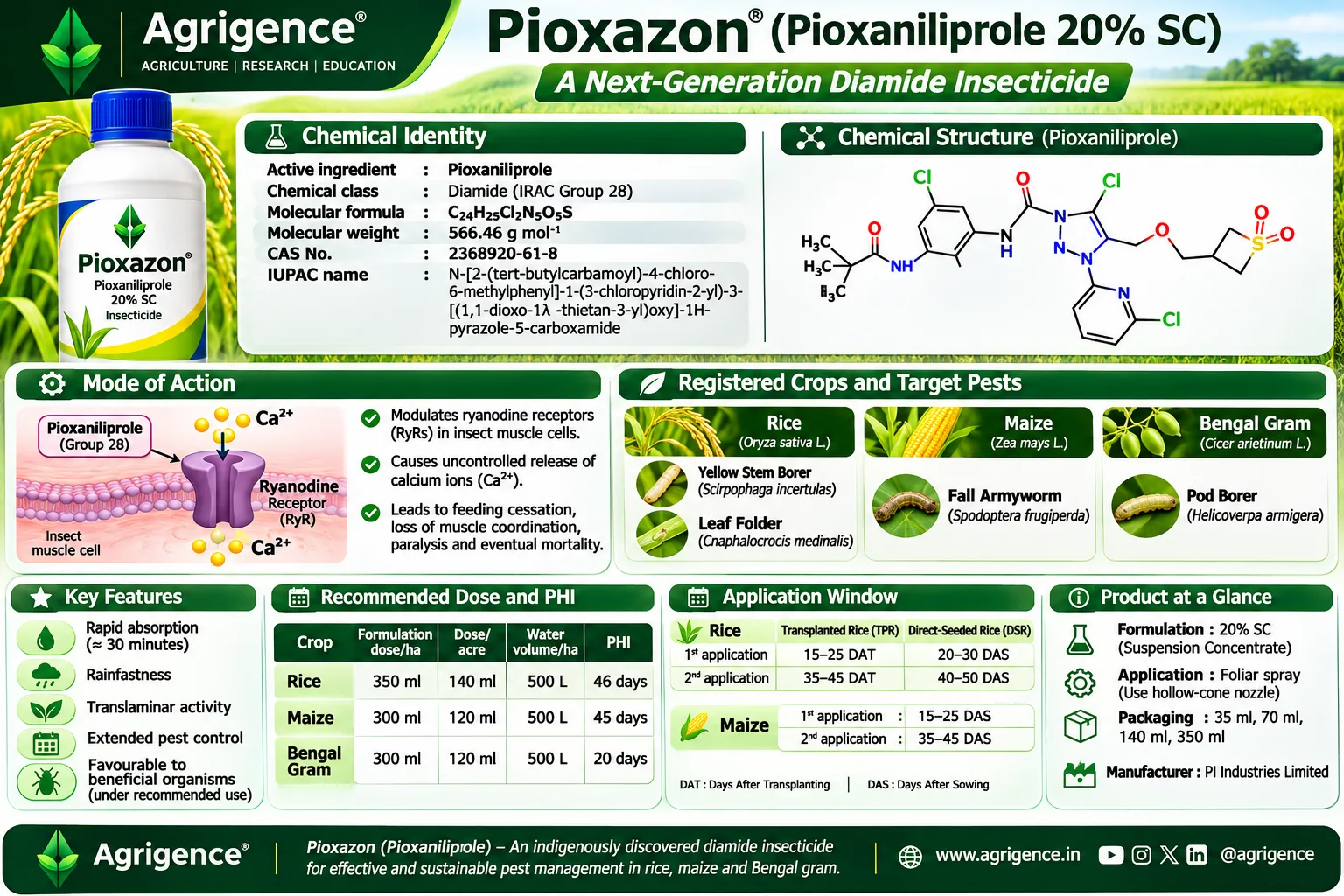
Pioxazon® is a new-generation insecticide introduced by PI Industries, powered by Pioxaniliprole, an indigenously discovered insecticide molecule. Formulated as Pioxaniliprole 20% SC, it has been developed to manage important insect pests in major agricultural crops, including rice, maize and Bengal gram.
The introduction of Pioxazon represents a significant development in India's agricultural research and crop protection industry. The molecule was developed through extensive research, scientific evaluation and multi-location field trials under diverse Indian agro-climatic conditions.
In this article, we will cover Pioxazon's composition, working mechanism, recommended crops, target pests, dosage, application timing, precautions and other important information for farmers and agriculture students.
Official Links & Direct Resources
1. What is Pioxazon Insecticide?
Pioxazon is a commercial insecticide brand of PI Industries. Its active ingredient is Pioxaniliprole, formulated as a 20% Suspension Concentrate (SC).
It belongs to the modern diamide group of insecticides and works by targeting the ryanodine receptors in insect muscles. This disrupts normal muscle function, resulting in feeding cessation, paralysis and eventually pest mortality.
PI Industries developed the molecule through its research and development programme in India. The company describes Pioxaniliprole as India's first insecticide active ingredient discovered through indigenous research.
Basic Information About Pioxazon
| Particular | Details |
|---|---|
| Trade Name | Pioxazon® |
| Manufacturer | PI Industries |
| Active Ingredient | Pioxaniliprole |
| Formulation | 20% SC |
| Product Category | Insecticide |
| Chemical Group | Diamide |
| IRAC Group | Group 28 (as classified in PI Industries' investor presentation) |
| Mode of Action | Ryanodine Receptor Modulation |
| Application Method | Foliar Spray |
| Target Crops | Rice, Maize and Bengal Gram |
| Formulation Type | Suspension Concentrate |
| Available Pack Sizes | 35 ml, 70 ml, 140 ml and 350 ml |
2. India's First Indigenously Discovered Insecticide Molecule
Pioxaniliprole represents a milestone in India's crop protection research and development sector.
According to PI Industries, the molecule was developed through more than a decade of research and scientific innovation at its Indian R&D facilities.
The development programme involved molecular discovery, biological evaluation, formulation research, toxicological assessment and multi-location agricultural field trials.
The company has highlighted the following research and development figures:
- More than 5,000 compounds screened.
- Participation of over 700 scientists.
- More than 10,000 field trials across different agro-climatic conditions.
- Collaboration with 25 leading agricultural institutions and universities.
- A reported one-in-100,000 chance of identifying a successful candidate molecule.
Pioxaniliprole received registration through the Central Insecticides Board and Registration Committee (CIB&RC), under the Ministry of Agriculture and Farmers Welfare, Government of India.
Its registration was approved during the 476th Registration Committee meeting held in September 2026.
PI Industries commercially launched Pioxazon on 31 October 2026.
3. How Does Pioxazon Work? (Mode of Action)
Pioxazon contains Pioxaniliprole, which acts on the ryanodine receptors present in insect muscle cells.
Ryanodine receptors regulate the release of calcium ions within muscle cells. This calcium movement is necessary for normal muscle contraction and relaxation.
When Pioxaniliprole affects these receptors, normal calcium regulation is disrupted.
Mechanism of Action
- Application: Pioxazon is applied to the crop through foliar spraying.
- Pest exposure: The insect comes into contact with or ingests the treated plant material.
- Ryanodine receptor disruption: The active ingredient affects the insect's ryanodine receptors.
- Feeding cessation: The insect stops feeding.
- Muscle paralysis: Normal muscle functioning becomes disrupted.
- Pest mortality: The affected insect eventually dies.
This action makes Pioxazon particularly relevant for managing important caterpillar pests such as Fall Armyworm, stem borers and pod borers.
4. Crops and Target Pests of Pioxazon
According to the manufacturer's registered product information, Pioxaniliprole 20% SC is approved for the following crop and pest combinations:
| Crop | Target Pest | Scientific Name |
|---|---|---|
| Rice | Yellow Stem Borer | Scirpophaga incertulas |
| Rice | Leaf Folder | Cnaphalocrocis medinalis |
| Maize | Fall Armyworm | Spodoptera frugiperda |
| Bengal Gram (Chana) | Pod Borer | Helicoverpa armigera |
These target pests cause significant damage to important cereal and pulse crops.
A. Pioxazon in Rice
Rice is one of the major crops targeted by Pioxazon. The product is recommended against:
*1. Yellow Stem Borer (Scirpophaga incertulas)*
The larvae enter the rice stem and damage the growing region inside the plant.
Common symptoms include:
- Dead heart in vegetative-stage plants.
- White earheads during the reproductive stage.
- Drying of the central shoot.
- Reduced productive tillers.
- Yield loss due to damaged stems and panicles.
*2. Rice Leaf Folder (Cnaphalocrocis medinalis)*
Leaf folder larvae fold or roll rice leaves and feed on the green leaf tissue.
Common symptoms include:
- Folded or rolled leaves.
- White or transparent feeding patches.
- Damaged leaf surfaces.
- Reduced photosynthetic area.
B. Pioxazon in Maize
*Target Pest: Fall Armyworm (Spodoptera frugiperda)*
Fall Armyworm is an important invasive insect pest of maize.
Young larvae initially feed on leaf surfaces, while older larvae damage the whorl, growing points and other aerial plant parts.
Common symptoms include:
- Window-pane damage on leaves.
- Irregular holes in leaves.
- Ragged leaf margins.
- Frass inside the maize whorl.
- Damage to tassels and developing cobs.
Pioxazon is recommended for Fall Armyworm management in maize.
C. Pioxazon in Bengal Gram
*Target Pest: Pod Borer (Helicoverpa armigera)*
Pod borer is one of the economically important insect pests of Bengal gram.
The larvae feed on flowers, developing pods and seeds.
Common symptoms include:
- Damaged flowers.
- Holes in pods.
- Larvae feeding on developing seeds.
- Reduced grain production.
- Poor-quality harvested produce.
Pioxazon is registered for managing pod borer in Bengal gram.
5. Pioxazon Insecticide Recommended Dose
The recommended dosage varies according to the crop and target pest.
The following information is based on PI Industries' published product recommendations.
| Crop | Target Pest | Dose per Acre | Water Volume per Acre |
|---|---|---|---|
| Rice | Yellow Stem Borer and Leaf Folder | 140 ml | 150–200 litres |
| Maize | Fall Armyworm | 120 ml | 150–200 litres |
| Bengal Gram | Pod Borer | 120 ml | 150–200 litres |
Important: Always follow the approved product label and accompanying leaflet for the specific crop, pest and application conditions. Do not increase or modify the recommended dose independently.
6. Dose and Pre-Harvest Interval (PHI)
The manufacturer's product information also provides dosage and pre-harvest interval details on a per-hectare basis.
| Crop | Formulation Dose per Hectare | Water Volume per Hectare | PHI |
|---|---|---|---|
| Maize | 300 ml | 500 litres | 45 days |
| Rice | 350 ml | 500 litres | 46 days |
| Bengal Gram | 300 ml | 500 litres | 20 days |
What is PHI?
PHI stands for Pre-Harvest Interval. It is the minimum waiting period between the last pesticide application and harvesting the crop.
For example, a PHI of 45 days means harvesting should take place only after at least 45 days have passed following the last application, subject to the product label.
7. When Should Pioxazon Be Applied?
Correct application timing is important for achieving effective pest management.
Rice
The manufacturer's crop guidance provides the following application windows:
| Application | Transplanted Rice (TPR) | Direct-Seeded Rice (DSR) |
|---|---|---|
| First Application | 15–25 DAT | 20–30 DAS |
| Second Application | 35–45 DAT | 40–50 DAS |
Where:
- DAT = Days After Transplanting.
- DAS = Days After Sowing.
- TPR = Transplanted Rice.
- DSR = Direct-Seeded Rice.
Maize
| Application | Recommended Window |
|---|---|
| First Application | 15–25 DAS |
| Second Application | 35–45 DAS |
The application schedule should be guided by field scouting, pest pressure and the approved label instructions.
Bengal Gram
Pioxazon is recommended against pod borer in Bengal gram. Apply according to pest monitoring, the recommended crop dose and the approved product label.
Do not assume that the same application schedule applies to every crop.
8. Important Features and Benefits of Pioxazon
1. Rapid Absorption
PI Industries reports absorption within approximately 30 minutes of application under its evaluated conditions.
2. Rainfastness
The formulation is reported to provide excellent rainfastness, helping maintain performance under variable weather conditions.
3. Effective Pest Control
Its molecular structure is designed to provide strong binding affinity to the target site in insect pests.
4. Translaminar Activity
Translaminar movement helps the active ingredient move through leaf tissues, contributing to insect control on treated plant surfaces.
5. Longer Duration of Control
According to the manufacturer, the active ingredient maintains availability in the plant system and provides extended pest control.
6. Crop Health and New Growth
PI Industries also highlights a phytotonic effect and benefits associated with crop vigour and protection of new growth.
7. Beneficial Insect Profile
The manufacturer reports a favourable safety profile for beneficial insects, including certain predatory spiders, beetles, ladybird beetles, damselflies and green lacewings, under recommended conditions.
However, no insecticide should be considered harmless to all non-target organisms. Follow the product label and integrated pest management recommendations.
9. Application Method and Spraying Instructions
Pioxazon is applied as a foliar spray.
The manufacturer's crop guidance recommends the use of a hollow-cone nozzle.
Important Application Guidelines
- Use the recommended quantity of Pioxazon for the respective crop.
- Maintain the prescribed water volume.
- Ensure uniform spray coverage.
- In maize, give particular attention to coverage of the crop whorl.
- Preferably spray during morning or evening hours.
- Avoid spraying under high-wind conditions.
- Follow the label instructions concerning weather and rainfall.
- Use suitable spraying equipment.
- Calibrate the sprayer before application.
10. Safety Precautions While Using Pioxazon
Pesticide handling requires proper precautions to protect farmers, farm workers and the environment.
Follow these safety measures:
- Wear appropriate protective clothing during mixing and spraying.
- Use chemical-resistant gloves, boots and protective eyewear.
- Avoid direct contact with the skin, eyes and mouth.
- Do not eat, drink, smoke or chew anything during pesticide application.
- Keep the product away from food, animal feed and drinking water.
- Do not reuse empty pesticide containers.
- Store the product in its original container.
- Keep the pesticide away from children and animals.
- Follow all disposal and re-entry instructions on the label.
- Wash hands and exposed skin after completing the application.
Always read the complete product label and attached leaflet before use.
11. Available Packing Sizes of Pioxazon
PI Industries lists the following packaging options:
| Packing Size |
|---|
| 35 ml |
| 70 ml |
| 140 ml |
| 350 ml |
Availability may vary according to the distributor and location.
For current pricing and authorised dealer information, contact PI Industries or check its official product website.
12. Who Manufactures Pioxazon?
Pioxazon is manufactured and marketed by PI Industries Limited, an Indian company operating in the agricultural sciences and crop protection sector.
The company has developed Pioxaniliprole through its research and development programme and received regulatory registration in India.
Official Contact Details:
- Company: PI Industries Limited
- Customer Care: 1800 208 1008
- Email: info@piind.com
- Official Website: https://www.piindustries.com/
- Pioxazon Website: https://pioxazon.piindustries.com/
13. Role of Pioxazon in Integrated Pest Management (IPM)
Integrated Pest Management is an important approach to sustainable crop protection.
Pioxazon can be considered as a chemical crop-protection option within an IPM programme for its registered target pests.
Farmers should combine appropriate chemical control with:
- Regular field monitoring.
- Pest identification and scouting.
- Conservation of natural enemies.
- Crop-residue and field sanitation practices.
- Timely application based on pest pressure.
- Rotation of insecticides with different modes of action to reduce resistance development.
Avoid unnecessary or repeated insecticide applications.
14. Frequently Asked Questions (FAQs)
Q1. What is the active ingredient in Pioxazon?
Pioxaniliprole is the active ingredient in Pioxazon.
Q2. What is the formulation of Pioxazon?
Pioxazon is available as Pioxaniliprole 20% SC (Suspension Concentrate).
Q3. Which company manufactures Pioxazon?
Pioxazon is a product of PI Industries Limited.
Q4. Which pests are controlled by Pioxazon?
The manufacturer's registered product information lists Yellow Stem Borer and Leaf Folder in rice, Fall Armyworm in maize, and Pod Borer in Bengal gram.
Q5. What is the Pioxazon dose in rice?
The manufacturer's recommended dose is 140 ml per acre in 150–200 litres of water.
Q6. What is the Pioxazon dose in maize?
The recommended dose is 120 ml per acre in 150–200 litres of water.
Q7. What is the Pioxazon dose in Bengal gram?
The recommended dose is 120 ml per acre in 150–200 litres of water.
Q8. What is the mode of action of Pioxazon?
Pioxaniliprole acts on ryanodine receptors in insect muscle cells, disrupting normal muscle function and leading to feeding cessation, paralysis and mortality.
Q9. What is the IRAC group of Pioxazon?
PI Industries' investor presentation identifies Pioxazon under IRAC Group 28.
Q10. What is the PHI of Pioxazon?
The manufacturer's published product information lists 45 days for maize, 46 days for rice and 20 days for Bengal gram.
Q11. Is Pioxazon a systemic insecticide?
The manufacturer highlights translaminar action and availability in the plant system. For the exact movement and use claims, refer to the formulation label and technical information.
Q12. Is Pioxazon suitable for organic farming?
Pioxazon is a chemical insecticide, not an organic or biological pesticide. Its use should be consistent with the applicable farming standards and certification requirements.
Q13. What is the full form of SC in Pioxazon 20% SC?
SC stands for Suspension Concentrate, a liquid pesticide formulation in which finely divided active ingredient particles are suspended in a liquid medium.
Conclusion
Pioxazon, powered by Pioxaniliprole 20% SC, represents a significant development in India's indigenous crop protection research. Developed by PI Industries, it introduces a new insecticide active ingredient for managing important pests in rice, maize and Bengal gram.
Its ryanodine receptor-based mode of action, crop-specific application recommendations and research-backed development make it an important addition to the crop protection sector.
Farmers should always identify the target pest correctly, follow the approved dosage, observe the pre-harvest interval and use suitable protective equipment during application.
Disclaimer: This article is intended for agricultural education and general information. Always refer to the latest approved product label and leaflet for crop registration, dose, application timing, safety instructions and harvesting restrictions. Do not use the product on crops or pests not covered by its approved label.