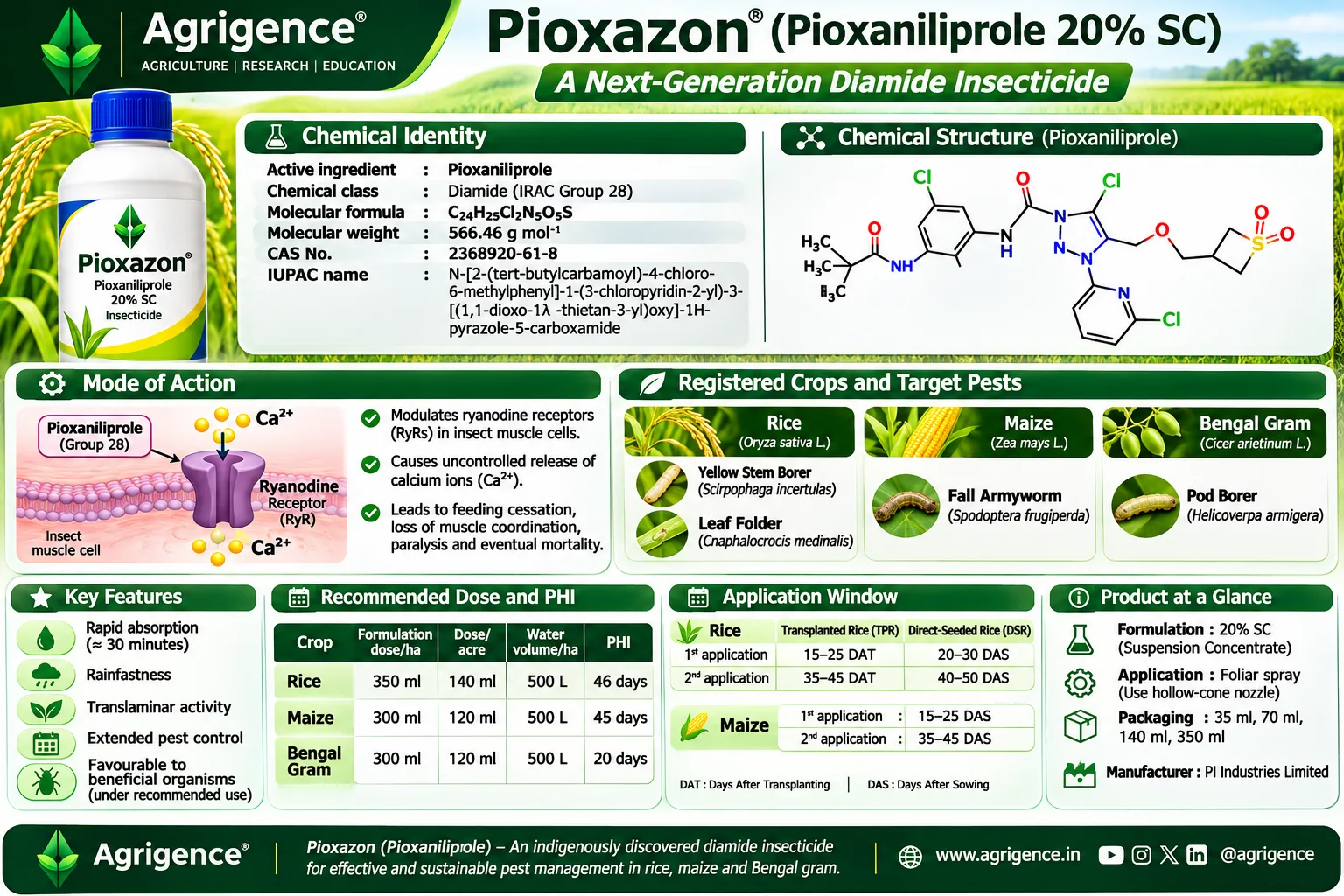
Pioxazon®, a commercial insecticide formulation developed by PI Industries Limited, contains Pioxaniliprole 20% SC as its active ingredient. Pioxaniliprole represents an important development in India's indigenous agricultural research and crop-protection innovation. The molecule is registered in India for the management of selected insect pests in rice (Oryza sativa L.), maize (Zea mays L.) and Bengal gram (Cicer arietinum L.).
Pioxaniliprole is a diamide insecticide associated with the modulation of ryanodine receptors in insect muscle cells. Its chemical identity is represented by the molecular formula C24H25Cl2N5O5S and a molecular weight of approximately 566.46 g mol⁻¹. Its registered applications target Yellow Stem Borer (Scirpophaga incertulas) and Leaf Folder (Cnaphalocrocis medinalis) in rice, Fall Armyworm (Spodoptera frugiperda) in maize and Pod Borer (Helicoverpa armigera) in Bengal gram.
This technical review presents available information concerning the chemical identity, formulation characteristics, proposed mode of action, target insect pests, crop-wise application recommendations, pre-harvest intervals, application methodology and safety considerations. Particular emphasis is placed on interpreting manufacturer-reported performance claims within the context of integrated pest management and insecticide resistance management.
Official Links & Direct Resources
Apply Online / Candidate Registration
Direct registration & application submission portal2. PI Industries Limited. (2026). *PI Industries Unveils Pioxaniliprole, India's First Indigenously Discovered Insecticide Molecule.* 29 October 2026.
External authority resourcePioxaniliprole.* CAS RN 2368920-61-8.
External authority resourcePioxaniliprole.* Chemical identity, molecular formula, CAS number and IUPAC nomenclature.
External authority resourcePioxaniliprole.
External authority resource6. Insecticide Resistance Action Committee (IRAC). *Mode of Action Classification of Insecticides.
External authority resourceRice Crop Protection and Application Recommendations.
External authority resourceMaize Crop Protection and Application Recommendations.
External authority resource9. Samurkas, A., et al. (2020). Structural basis for diamide modulation of ryanodine receptor. *Nature Chemical Biology.
External authority resourceKeywords: Pioxazon, Pioxaniliprole, molecular formula, chemical structure, diamide insecticide, ryanodine receptor, rice stem borer, Fall Armyworm, Helicoverpa armigera, insect pest management, crop protection.
1. Introduction
Insect pests constitute one of the major biological constraints affecting agricultural productivity and crop quality. Their feeding activities can damage vegetative structures, reproductive organs and economically important plant parts, resulting in substantial yield losses under favourable pest-development conditions.
Conventional crop-protection strategies increasingly encounter challenges associated with insecticide resistance, changes in pest populations, environmental considerations and the need for more selective pest-management technologies.
The discovery and development of insecticide molecules with distinct biological activity have therefore become important components of modern agricultural research.
In this context, PI Industries Limited introduced Pioxaniliprole, commercially formulated as Pioxazon® (Pioxaniliprole 20% SC). The molecule was developed through the company's indigenous research and development programme in India.
According to PI Industries, Pioxaniliprole is India's first indigenously discovered insecticide active ingredient. The molecule was unveiled on 29 October 2026 and Pioxazon was commercially launched on 31 October 2026.
Its development is significant from the perspective of domestic agrochemical research, proprietary molecular discovery and the advancement of crop-protection technologies in India.
2. Product Identification and General Characteristics
Pioxazon is a proprietary insecticide formulation developed and marketed by PI Industries Limited.
2.1 General Product Information
| Parameter | Technical information |
|---|---|
| Commercial name | Pioxazon® |
| Active ingredient | Pioxaniliprole |
| Formulation | 20% SC |
| Formulation type | Suspension Concentrate |
| Product category | Insecticide |
| Chemical class | Diamide |
| Manufacturer | PI Industries Limited |
| Application method | Foliar spray |
| Registered crops | Rice, maize and Bengal gram |
| Packaging | 35 ml, 70 ml, 140 ml and 350 ml |
SC refers to Suspension Concentrate, a liquid pesticide formulation in which finely divided particles of the active ingredient remain dispersed in a liquid medium.
2.2 Molecular Formula and Chemical Identity
The molecular formula of Pioxaniliprole is C24H25Cl2N5O5S.
This formula represents the elemental composition of the pure active ingredient, rather than the entire commercial 20% SC formulation, which also contains formulation additives and other non-active constituents.
Physicochemical and Chemical Identification Data
| Parameter | Value |
|---|---|
| Chemical name | Pioxaniliprole |
| Molecular formula | C24H25Cl2N5O5S |
| Molecular weight | Approximately 566.46 g mol⁻¹ |
| CAS Registry Number | 2368920-61-8 |
| Chemical class | Diamide insecticide |
| IUPAC name | N-[2-(tert-butylcarbamoyl)-4-chloro-6-methylphenyl]-1-(3-chloropyridin-2-yl)-3-[(1,1-dioxo-1λ⁶-thietan-3-yl)oxy]-1H-pyrazole-5-carboxamide |
| InChIKey | HHQJTWVMZLKJIY-UHFFFAOYSA-N |
Chemical structure: The molecule contains a substituted phenyl group, a pyrazole ring, a chloropyridine moiety and an oxidised thietane-containing substituent. These structural features form part of its distinctive molecular architecture.
The structural representation and molecular identifiers are available through PubChem and the BCPC Pesticide Compendium.
2.3 Significance of the Molecular Structure
The chemical structure of an insecticide is closely associated with its biological activity, target-site interactions, physicochemical behaviour and toxicological characteristics.
Pioxaniliprole possesses a heterocyclic molecular architecture containing nitrogen-, oxygen-, chlorine- and sulphur-containing structural components.
Its structure includes:
- A substituted phenyl ring.
- A pyrazole heterocyclic ring.
- A chlorinated pyridine group.
- A thietane sulfone-containing moiety.
- Amide functional groups.
The molecular architecture is relevant to understanding its reported biological interaction with insect physiological systems.
However, specific molecular-binding interactions, quantitative receptor-affinity values and structure–activity relationships require independent biochemical and molecular investigations.
3. Indigenous Research and Development
According to PI Industries, the discovery and development of Pioxaniliprole involved an extended research programme incorporating molecular screening, biological evaluation, formulation development and field validation.
The company has reported the following research indicators:
- More than 5,000 compounds screened.
- Participation of over 700 scientists.
- More than 10,000 field trials across different agro-climatic conditions.
- Collaboration with 25 agricultural institutions and universities.
These figures represent manufacturer-reported research and development activities rather than independently audited experimental results presented in this review.
The successful registration and commercialisation of the molecule demonstrate the potential of indigenous research programmes to contribute to proprietary crop-protection technologies.
4. Chemistry and Mode of Action
4.1 Biological Target
Pioxaniliprole is described as an insecticide associated with ryanodine receptor activity in insect muscle cells.
Ryanodine receptors (RyRs) are intracellular calcium-release channels involved in regulating calcium-ion movement within muscle cells.
Calcium ions play a fundamental role in physiological processes associated with muscle contraction and relaxation.
Disruption of calcium regulation can interfere with normal muscular activity.
4.2 Physiological Implications of Ryanodine Receptor Modulation
The established mode of action of Group 28 diamide insecticides involves modulation of insect ryanodine receptors, which can cause uncontrolled calcium release from intracellular stores.
The resulting physiological disturbance may lead to:
- Abnormal calcium-ion regulation.
- Disruption of normal muscle contraction.
- Feeding cessation.
- Loss of muscular coordination.
- Paralysis and eventual insect mortality.
PI Industries describes Pioxaniliprole as acting on ryanodine receptors and associates this mechanism with feeding cessation, paralysis and pest mortality.
The detailed molecular binding characteristics of Pioxaniliprole should not automatically be assumed to be identical to those of every previously established diamide insecticide.
4.3 Insecticide Resistance Action Committee Classification
Pioxaniliprole is identified as an IRAC Group 28 active ingredient in the University of Hertfordshire Pesticide Properties Database.
IRAC Group 28 is designated as Ryanodine Receptor Modulators and includes established diamide insecticides.
The latest official IRAC classification and the product label should be consulted when designing insecticide rotation programmes.
5. Registered Crops and Target Insect Pests
According to PI Industries' published product recommendations, Pioxaniliprole 20% SC has registered applications against selected insect pests in three major agricultural crops.
5.1 Rice (Oryza sativa L.)
Target pests:
- Yellow Stem Borer – Scirpophaga incertulas
- Rice Leaf Folder – Cnaphalocrocis medinalis
A. Yellow Stem Borer
Yellow Stem Borer is an economically important insect pest of rice.
The larval stage enters the rice stem and feeds internally, damaging the growing region of the plant.
Characteristic symptoms include dead heart during the vegetative stage, white earheads during the reproductive stage, drying of the central shoot, reduced productive tillers and impaired grain formation.
B. Rice Leaf Folder
Rice Leaf Folder larvae feed on leaf tissues and generally fold or roll leaves around themselves.
The principal symptoms include folded leaves, transparent feeding patches, loss of photosynthetically active leaf tissue and reduced functional leaf area under substantial infestation.
Management should consider pest population density, crop growth stage and the presence of natural enemies.
5.2 Maize (Zea mays L.)
Target pest:
Fall Armyworm – Spodoptera frugiperda
Fall Armyworm is a polyphagous insect pest belonging to the family Noctuidae.
In maize, larvae initially feed on leaf surfaces and subsequently cause characteristic injury to the whorl, newly emerging leaves and reproductive structures.
Important field symptoms include window-pane feeding damage, irregular holes in leaves, ragged leaf margins, larval frass inside the whorl and damage to tassels and developing cobs.
Severe infestation during early crop development can adversely affect plant growth and yield potential.
Pioxazon is registered for the management of Fall Armyworm in maize.
5.3 Bengal Gram (Cicer arietinum L.)
Target pest:
Pod Borer – Helicoverpa armigera
Helicoverpa armigera is a major agricultural pest affecting several pulse, oilseed and horticultural crops.
In Bengal gram, larvae feed on reproductive structures, including flowers and developing pods.
Typical symptoms include flower feeding, holes in developing pods, consumption of developing seeds, reduced pod development and deterioration of harvested grain quality.
Pioxazon is registered for the management of Pod Borer in Bengal gram.
6. Crop-Wise Recommended Dose and Application Details
The manufacturer's published product information provides crop-specific recommendations for formulation dose, water volume and pre-harvest interval.
6.1 Recommended Dosage
| Crop | Target pest | Formulation dose/ha | Dose per acre |
|---|---|---|---|
| Rice | Yellow Stem Borer and Leaf Folder | 350 ml | 140 ml |
| Maize | Fall Armyworm | 300 ml | 120 ml |
| Bengal Gram | Pod Borer | 300 ml | 120 ml |
6.2 Water Volume and Pre-Harvest Interval
| Crop | Water volume/ha | PHI |
|---|---|---|
| Rice | 500 litres | 46 days |
| Maize | 500 litres | 45 days |
| Bengal Gram | 500 litres | 20 days |
PHI: Pre-Harvest Interval.
6.3 Significance of the Pre-Harvest Interval
The Pre-Harvest Interval represents the minimum period required between the final pesticide application and harvesting.
The recommended PHI values for Pioxazon are:
- Rice: 46 days.
- Maize: 45 days.
- Bengal gram: 20 days.
Observance of the prescribed PHI is essential for pesticide-residue management and compliance with applicable food-safety requirements.
The approved product label and leaflet should remain the final reference for application and harvesting restrictions.
7. Crop-Specific Application Windows
PI Industries also publishes crop-specific application windows on its official Pioxazon product website.
7.1 Rice
| Application | Transplanted rice (TPR) | Direct-seeded rice (DSR) |
|---|---|---|
| First application window | 15–25 DAT | 20–30 DAS |
| Second application window | 35–45 DAT | 40–50 DAS |
7.2 Maize
| Application | Crop stage |
|---|---|
| First application window | 15–25 DAS |
| Second application window | 35–45 DAS |
Terminology:
- DAT: Days After Transplanting.
- DAS: Days After Sowing.
- TPR: Transplanted Rice.
- DSR: Direct-Seeded Rice.
These are manufacturer-published application windows and should not be interpreted as a recommendation to spray automatically on fixed calendar dates. Actual application should be guided by pest monitoring and approved product-label instructions.
For Bengal gram, the formulation dose and PHI are available in the manufacturer's product information. A specific application calendar should not be assumed without reference to the approved label.
8. Application Technology and Spray Methodology
Pioxazon is recommended for foliar application.
The manufacturer's application guidance specifies the use of a hollow-cone nozzle and appropriate manual, battery-operated, power-operated or tractor-mounted spraying equipment.
8.1 Preparation of Spray Solution
- Shake the product container before use.
- Measure the required quantity of formulation.
- Mix the measured quantity with a small amount of clean water.
- Add the remaining quantity of water gradually while maintaining agitation.
- Ensure adequate mixing before application.
8.2 Spray Equipment
Recommended spraying equipment includes:
- Manual sprayers.
- Battery-operated sprayers.
- Power sprayers.
- Tractor-mounted sprayers.
8.3 Spray Coverage
Uniform spray coverage is important for achieving the intended pesticide application.
Particular attention should be given to crop parts associated with pest activity.
In maize, the crop whorl should receive adequate spray coverage because Fall Armyworm larvae commonly occupy and feed within this region.
9. Manufacturer-Reported Performance Characteristics
PI Industries identifies several performance characteristics associated with Pioxazon.
These include absorption, rainfastness, pest-control efficacy, duration of control, translaminar activity and selectivity towards beneficial organisms.
9.1 Absorption and Rainfastness
The manufacturer reports absorption within approximately 30 minutes under its evaluated conditions and highlights rainfastness based on its testing.
These claims should be interpreted in relation to the experimental conditions, crop stage, environmental conditions and application methodology used during evaluation.
9.2 Translaminar Activity
Translaminar activity describes the movement of an applied active ingredient through leaf tissues.
This characteristic may contribute to insecticide exposure on leaf surfaces that are not directly accessible to the original spray deposit.
9.3 Duration of Pest Control
The company reports extended availability of the active ingredient in the plant system and sustained pest-control performance.
However, actual duration of control can vary depending on target insect species, pest population density, crop growth stage, weather conditions, spray coverage and insecticide resistance status.
9.4 Beneficial Organisms
The manufacturer reports a favourable ecotoxicological profile for selected beneficial organisms under recommended application conditions.
This does not imply universal safety to all non-target organisms. Pollinators, predators, parasitoids and aquatic organisms must be considered when developing field-level pesticide application strategies.
10. Role in Integrated Pest Management
Integrated Pest Management (IPM) is an ecological approach to pest suppression that combines multiple compatible management strategies.
Pioxazon may be incorporated into an IPM programme for its registered target pests when its use is justified by field conditions and approved recommendations.
Important IPM components include:
- Regular field surveillance and pest monitoring.
- Correct identification of target insect species.
- Appropriate cultural and mechanical management.
- Conservation of naturally occurring predators and parasitoids.
- Judicious chemical application.
- Rotation of insecticides with genuinely different modes of action.
11. Insecticide Resistance Management
Insecticide resistance is an important concern in modern crop protection.
Repeated and exclusive application of insecticides acting at the same physiological target may exert selection pressure on insect populations, favouring individuals that possess resistance-associated characteristics.
Resistance-management practices should include rotation of insecticides with different modes of action, avoidance of unnecessary repeat applications, compliance with maximum application limits specified on the label, integration of biological and cultural management strategies and monitoring of field-level treatment performance.
Pioxaniliprole should be included in resistance-management programmes according to its verified IRAC classification and approved product recommendations.
12. Toxicological and Operational Safety
The safe handling of pesticides is essential for protecting pesticide applicators, farm workers, livestock and the surrounding environment.
The following measures should be adopted:
- Wear appropriate protective clothing.
- Use chemical-resistant gloves, protective footwear and eye protection.
- Avoid direct contact with skin, eyes and mouth.
- Do not eat, drink or smoke during pesticide handling.
- Prevent contamination of drinking-water sources.
- Store the formulation in its original labelled container.
- Keep the pesticide away from children, food and animal feed.
- Do not reuse empty pesticide containers.
- Follow product-specific disposal and re-entry instructions.
- Wash exposed skin and hands thoroughly after application.
Specific toxicological classification, first-aid instructions, antidotal information and environmental precautions should be obtained from the approved product label and Safety Data Sheet.
13. Packaging and Commercial Availability
PI Industries lists Pioxazon in the following packaging sizes:
| Packaging option |
|---|
| 35 ml |
| 70 ml |
| 140 ml |
| 350 ml |
Product availability and commercial terms may vary across geographical markets and distribution channels.
For authorised dealer information, product details and current availability, farmers should refer to the manufacturer's official website.
14. Research Perspective and Future Scope
The development of Pioxaniliprole provides an opportunity to examine the contribution of domestic molecular discovery to India's crop-protection research ecosystem.
Several areas merit further investigation.
14.1 Multi-Location Efficacy Evaluation
Independent field experiments across different agro-climatic regions would help establish the consistency of pest-control performance under varying environmental conditions.
14.2 Molecular Mode-of-Action Research
Further biochemical and molecular investigations could help characterise the interaction between Pioxaniliprole and its target site, including receptor-binding characteristics.
14.3 Resistance Monitoring
Long-term monitoring of target pest populations is necessary to identify possible changes in insecticide sensitivity.
14.4 Non-Target Organism Assessment
Further ecotoxicological evaluation would help establish the effects of recommended applications on beneficial arthropods and other relevant non-target organisms.
14.5 Crop-Specific Application Research
Studies examining application timing, crop growth stage, spray coverage, weather conditions and pesticide-residue behaviour could strengthen evidence-based recommendations.
15. Limitations of Available Information
The present article is a product-focused technical review based primarily on publicly available manufacturer and scientific database information.
Although the manufacturer reports multi-location field trials, simulated-rainfall testing and ecotoxicological assessments, the complete experimental protocols, raw data and detailed statistical analyses were not available in the public materials reviewed for this article.
Consequently, comparative claims regarding efficacy, persistence, safety and superiority over other insecticides have not been independently established here.
Further peer-reviewed research would be valuable for independently evaluating the molecule's biological performance, selectivity and long-term contribution to sustainable crop protection.
16. Conclusion
Pioxazon (Pioxaniliprole 20% SC) represents an important development in indigenous insecticide discovery and commercial crop-protection technology in India.
Its active ingredient, Pioxaniliprole, has the molecular formula C24H25Cl2N5O5S and an approximate molecular weight of 566.46 g mol⁻¹. Its registered applications cover selected economically important insect pests in rice, maize and Bengal gram.
The product's reported biological activity involves ryanodine receptor-related mechanisms associated with disruption of insect muscular functioning.
The crop-wise recommendations, formulation dosage and pre-harvest intervals provide a technical framework for registered use. Nevertheless, appropriate pest identification, field monitoring, application timing, protective measures and resistance-management practices remain essential for responsible insecticide utilisation.
From an agricultural research perspective, Pioxaniliprole also highlights the importance of indigenous molecular discovery and the need for continued independent assessment of newly developed crop-protection molecules.
References and Further Reading
- PI Industries Limited. (2026). Pioxazon: Product Information, Composition, Crop Recommendations and Application Guidelines. https://www.piindustries.com/pi-products/pioxazon/
- PI Industries Limited. (2026). PI Industries Unveils Pioxaniliprole, India's First Indigenously Discovered Insecticide Molecule. 29 October 2026. https://www.piindustries.com/newsroom/pi-industries-unveils-pioxaniliprole-indias-first-indigenously-discovered-insecticide-molecule/
- National Center for Biotechnology Information. PubChem Compound Summary: Pioxaniliprole. CAS RN 2368920-61-8. https://pubchem.ncbi.nlm.nih.gov/compound/Pioxaniliprole
- BCPC. Compendium of Pesticide Common Names: Pioxaniliprole. Chemical identity, molecular formula, CAS number and IUPAC nomenclature. https://www.bcpcpesticidecompendium.org/pioxaniliprole.html
- University of Hertfordshire. Pesticide Properties Database: Pioxaniliprole. https://sitem.herts.ac.uk/aeru/iupac/Reports/3805.htm
- Insecticide Resistance Action Committee (IRAC). Mode of Action Classification of Insecticides. https://irac-online.org/documents/moa-classification/
- PI Industries Limited. Pioxazon: Rice Crop Protection and Application Recommendations. https://pioxazon.piindustries.com/crops/rice
- PI Industries Limited. Pioxazon: Maize Crop Protection and Application Recommendations. https://pioxazon.piindustries.com/crops/maize
- Samurkas, A., et al. (2020). Structural basis for diamide modulation of ryanodine receptor. Nature Chemical Biology. https://doi.org/10.1038/s41589-020-0627-5
Editorial Disclaimer: This article is intended for scientific education and agricultural information. The molecular characteristics refer to the active ingredient and not the complete commercial formulation. Registered uses, application rates, pre-harvest intervals and safety instructions must be verified against the latest approved product label and leaflet. This article does not replace official pesticide-use directions or independent field experimentation.