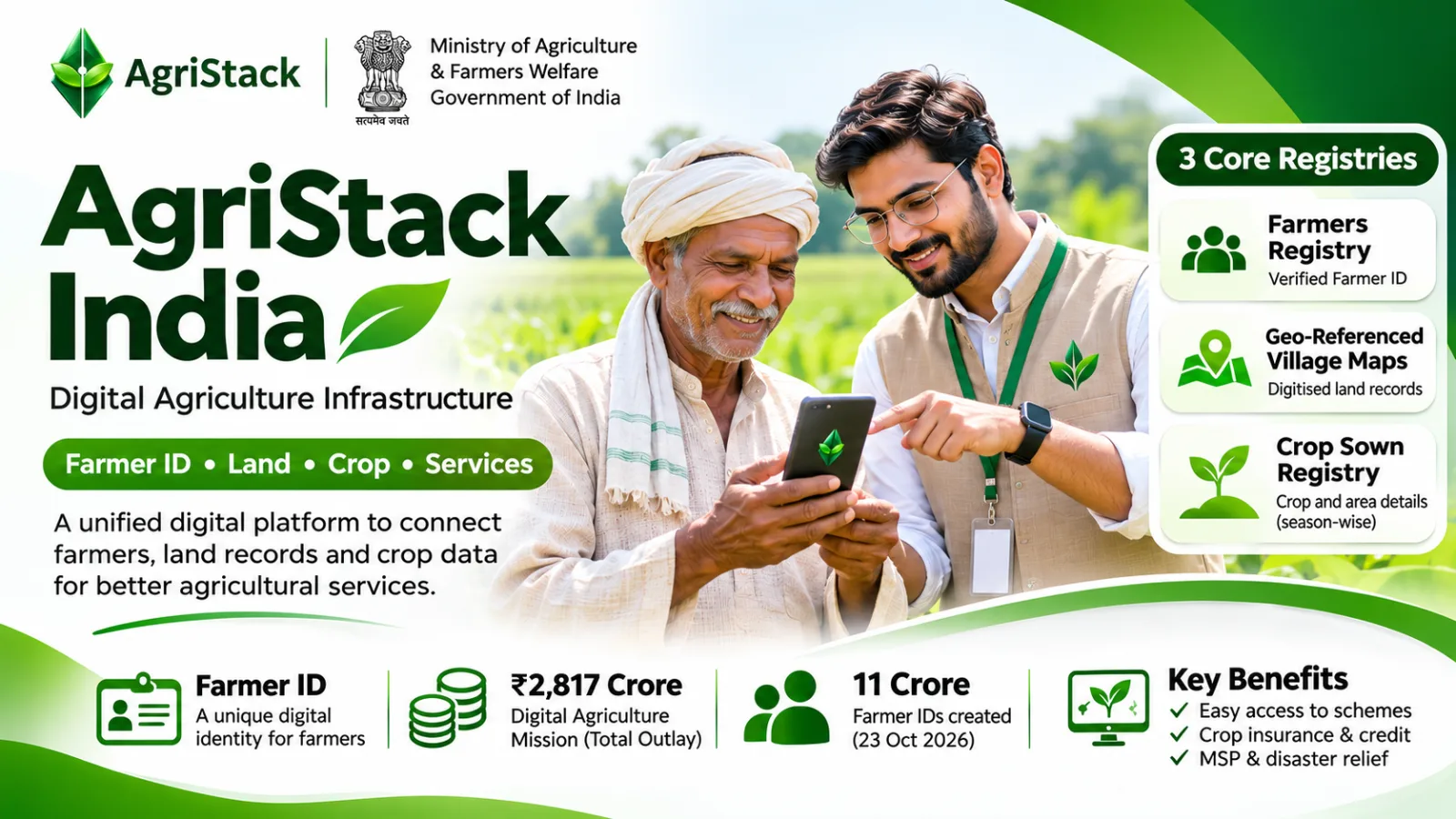
AgriStack is a major digital agriculture initiative launched by the Government of India to create a unified digital infrastructure for farmers, agricultural land and crop-related information. Developed under the Ministry of Agriculture and Farmers Welfare, AgriStack aims to simplify access to government agricultural schemes, crop insurance, institutional credit, Minimum Support Price (MSP) procurement and other farmer services.
The initiative provides farmers with a unique digital identity known as Farmer ID, which connects verified farmer information with digitised land records and other agricultural databases. It is designed to reduce repeated documentation, improve transparency in government schemes and make agricultural service delivery more efficient.
As part of the Digital Agriculture Mission, the government initially targeted the creation of 11 crore Farmer IDs by 31 March 2027. This target was achieved ahead of schedule, with 11 crore Farmer IDs reportedly generated by 23 October 2026.
Farmers can register through their respective state Farmer Registry portals, authorised Common Service Centres (CSCs), agriculture department offices and other approved registration facilities.
AgriStack 2026: Overview
| Particulars | Details |
|---|---|
| Initiative | AgriStack |
| Parent Mission | Digital Agriculture Mission |
| Ministry | Ministry of Agriculture and Farmers Welfare |
| Government | Government of India |
| Main Objective | Digital Agriculture Infrastructure |
| Farmer Identity | Unique Farmer ID |
| Main Registries | 3 |
| Total Mission Outlay | ₹2,817 Crore |
| Central Government Share | ₹1,940 Crore |
| Farmer ID Target | 11 Crore |
| Target Achievement | 23 October 2026 |
| Latest Reported Farmer IDs | 11 Crore |
| Implementing Authorities | Central and State Governments / UTs |
| Registration Mode | Online and Assisted Registration |
| Official Portal | https://agristack.gov.in/ |
Latest Update (24 October 2026): The Ministry of Agriculture and Farmers Welfare announced that 11 crore Farmer IDs had been created by the night of 23 October 2026, approximately five months ahead of the original deadline of 31 March 2027.
What is AgriStack?
AgriStack is a Digital Public Infrastructure (DPI) designed specifically for India's agriculture sector. It works as a digital backbone connecting farmer identities, agricultural land records and crop information through interconnected government databases.
Traditionally, farmers have had to submit similar documents repeatedly while applying for different government schemes, agricultural loans, crop insurance and procurement services. AgriStack aims to reduce this duplication by creating a verified digital record that authorised government systems can use for relevant services.
The system is designed to connect information such as:
- Farmer identity and demographic details.
- Agricultural land ownership records.
- Geographical details of agricultural plots.
- Crops cultivated during different agricultural seasons.
- Livestock and fisheries-related information, where integrated.
- Government schemes and benefits received.
- Agricultural services and institutional credit information.
AgriStack follows a federated architecture. State and Union Territory governments create and maintain their respective registry databases, while the central government provides common technological infrastructure, standards and implementation support.
Important: AgriStack is not another name for Aadhaar. Farmer ID is a separate agricultural identity that can be linked with Aadhaar authentication and verified land and crop information.
Digital Agriculture Mission: Budget and Objectives
The Union Cabinet approved the Digital Agriculture Mission on 2 September 2024 with a total financial outlay of ₹2,817 crore, including a central government share of ₹1,940 crore.
The mission aims to establish a comprehensive digital agriculture ecosystem using digital public infrastructure, geospatial information, artificial intelligence, remote sensing and agricultural data analytics.
Major Objectives
- Create digital identities for approximately 11 crore farmers.
- Establish reliable and interconnected farmer databases.
- Develop digital records of agricultural land and crops.
- Improve access to agricultural credit and government schemes.
- Strengthen crop production estimation.
- Support precision agriculture and data-based decision-making.
- Improve crop insurance and disaster relief delivery.
- Promote digital agricultural services and farmer advisory systems.
- Generate employment opportunities through digital crop surveys and ground-level data collection.
The government also estimated that digital crop surveys and ground-truthing activities could create employment opportunities for approximately 2.5 lakh trained local youth and Krishi Sakhis.
Three Major Registries Under AgriStack
AgriStack consists of three foundational agricultural registries. These registries collectively provide information about farmers, agricultural land and crops cultivated.
1. Farmers Registry
The Farmers Registry is the core database of AgriStack. It creates a unique digital identity for eligible farmers by connecting their personal details with digitised state land records.
Each successfully registered farmer receives a Farmer ID.
The registry is designed to contain or connect information relating to:
- Farmer name and demographic details.
- Aadhaar-linked authentication.
- Agricultural landholding records.
- Land ownership and cultivation details.
- Livestock and fisheries information, where integrated.
- Crop-related information.
- Government schemes and benefits.
- Other agricultural service records.
The application also provides for the onboarding of tenants and sharecroppers. However, their inclusion depends on the respective State Government's policy.
2. Geo-Referenced Village Maps
Geo-Referenced Village Maps are digitised village cadastral maps connected with geographical coordinates.
These maps help identify agricultural land parcels using geographical information and connect them with the relevant land records.
Major features include:
- Digitisation of village land maps.
- Geographical identification of agricultural plots.
- Mapping of survey and sub-survey numbers.
- Integration with land ownership databases.
- Improved identification of individual agricultural parcels.
- Support for digital crop surveys and agricultural planning.
This registry is important because the system needs to identify not only the farmer but also the geographical location of the agricultural land.
3. Crop Sown Registry
The Crop Sown Registry records the crops cultivated on agricultural plots during different seasons.
Information is collected through the Digital Crop Survey (DCS), which uses mobile applications and field-level verification.
The survey can record:
- Farmer ID.
- Farm or plot identification.
- Village and geographical details.
- Crop name.
- Cultivated area.
- Agricultural season.
- Sowing date.
- Photographs and geographical coordinates.
The information can help government departments estimate crop areas, plan procurement, monitor agricultural production and improve crop insurance assessment.
According to the Ministry of Agriculture, the Digital Crop Survey during Kharif 2025 covered more than 28.5 crore plots across 604 districts.
Latest AgriStack Farmer ID Progress 2026
The Government of India has reported significant progress in creating Farmer IDs under the Digital Agriculture Mission.
Important Milestones
| Date | Farmer ID Progress |
|---|---|
| 5 December 2024 | 29.99 Lakh |
| 28 March 2025 | 4.85 Crore |
| 27 November 2025 | 7.63 Crore |
| 4 February 2026 | 8.48 Crore |
| 19 March 2026 | 9.20 Crore |
| 6 August 2026 | 10.33 Crore |
| 23 October 2026 | 11 Crore |
Major Achievement: The government achieved the target of generating 11 crore Farmer IDs five months before the original deadline.
The Ministry also reported that more than 6 crore farmers had received direct benefits through Farmer ID-based service delivery under various government schemes.
These numbers represent different measurements: Farmer IDs generated and farmers receiving reported service benefits should not be treated as identical figures.
State-Wise Farmer ID Statistics
According to the Ministry of Agriculture and Farmers Welfare, the following state-wise Farmer ID figures were reported as of 19 March 2026.
| State | Farmer IDs Generated |
|---|---|
| Uttar Pradesh | 1,99,75,651 |
| Maharashtra | 1,31,81,173 |
| Madhya Pradesh | 1,04,30,155 |
| Rajasthan | 83,39,049 |
| Karnataka | 60,75,905 |
| Gujarat | 60,20,891 |
| Andhra Pradesh | 49,32,802 |
| Bihar | 46,94,398 |
| Telangana | 44,52,700 |
| Tamil Nadu | 34,76,396 |
| Chhattisgarh | 32,86,170 |
| Kerala | 22,50,877 |
| Odisha | 14,70,707 |
| Assam | 12,78,378 |
| Haryana | 11,34,650 |
| Himachal Pradesh | 5,80,030 |
| Uttarakhand | 1,50,747 |
| Punjab | 75,681 |
| Tripura | 63,325 |
| Total | 9,18,69,685 |
Note: These are historical state-wise figures, not current November 2026 totals. The national total subsequently reached 11 crore in October 2026.
Uttar Pradesh recorded the highest number of Farmer IDs in this March 2026 snapshot, with approximately 1.99 crore registrations.
Farmer ID Registration 2026: How to Apply Online
Farmers can register through their respective state Farmer Registry portals or authorised offline registration facilities.
The exact registration process and available options vary between states.
Step-by-Step Registration Process
Step 1: Visit the State Farmer Registry Portal
Open your state's official Farmer Registry portal through the AgriStack platform.
For Uttar Pradesh, use:
https://upfr.agristack.gov.in/farmer-registry-up/
Step 2: Create a New Account
Select the Farmer Registration or Sign Up option and enter the required details.
Step 3: Aadhaar Verification
Complete the prescribed Aadhaar authentication process. Depending on the portal, authentication may be available through OTP or other approved methods.
Step 4: Enter Personal Details
Provide the required farmer information and verify the details displayed on the registration portal.
Step 5: Add Agricultural Land Details
Enter or retrieve the required land information, such as:
- State.
- District.
- Sub-district or tehsil.
- Village.
- Survey number.
- Sub-survey number.
- Landowner details.
Step 6: Verify Land Records
Check whether the agricultural land shown on the portal matches the relevant state land records.
Where available, use the facility to fetch and verify all land parcels.
Step 7: Submit Registration
Review the information and submit the Farmer Registry application.
Step 8: Check Enrollment Status
Use the enrollment status facility to track the application and check whether verification has been completed.
After successful verification, the Farmer ID is generated according to the state's registration process.
Documents Required for Farmer ID Registration
Farmers may need the following documents and information:
| Document / Information | Purpose |
|---|---|
| Aadhaar Card | Identity verification |
| Aadhaar-Linked Mobile Number | OTP authentication, where required |
| Land Records | Ownership verification |
| Khasra / Khatauni | Agricultural land identification |
| Jamabandi / 7/12 Extract | State-specific land records |
| Bank Account Details | Relevant scheme and payment services |
| Mobile Number | Registration and communication |
| Additional Supporting Documents | As required by state rules |
The exact documents depend on the state registry and the farmer's registration category.
Uttar Pradesh Farmer Registry: Registration and Official Portal
Uttar Pradesh has developed a dedicated Farmer Registry portal under the AgriStack initiative.
Farmers in Uttar Pradesh can use the portal for registration, land verification, enrollment tracking and grievance-related services.
Official Uttar Pradesh Farmer Registry:
https://upfr.agristack.gov.in/farmer-registry-up/
Available Portal Facilities
- Farmer registration.
- Aadhaar-based e-KYC.
- Addition of agricultural land details.
- Verification of land parcels.
- Enrollment status checking.
- Farmer information viewing.
- Updating eligible information.
- Registration grievance facilities.
- Assisted registration through authorised channels.
Uttar Pradesh Farmer Registry User Manual
Farmers who need detailed instructions can refer to the official registration manual.
Download Uttar Pradesh Farmer Registry User Manual (PDF)
The manual explains self-registration, Aadhaar e-KYC, land-detail retrieval, land verification and enrollment-related procedures.
State-Wise AgriStack Farmer Registry Portals
The following state portal addresses were listed in the compiled state-wise registry information. Portal access and functionality can change, so verify the link through the national AgriStack portal before entering personal information.
| State | Farmer Registry Portal |
|---|---|
| Uttar Pradesh | https://upfr.agristack.gov.in/ |
| Gujarat | https://gjfr.agristack.gov.in/ |
| Maharashtra | https://mhfr.agristack.gov.in/ |
| Madhya Pradesh | https://mpfr.agristack.gov.in/ |
| Andhra Pradesh | https://apfr.agristack.gov.in/ |
| Rajasthan | https://rjfr.agristack.gov.in/ |
| Odisha | https://odfr.agristack.gov.in/ |
| Bihar | https://bhfr.agristack.gov.in/ |
| Kerala | https://klfr.agristack.gov.in/ |
| Tamil Nadu | Farmer Registry TN mobile application |
National Portal: https://agristack.gov.in/
Use only official government portals. Do not enter Aadhaar information, OTPs or land details on unofficial websites.
Benefits of AgriStack and Farmer ID for Farmers
AgriStack is designed to improve the delivery of agricultural services by connecting farmer identity, land records and crop information.
1. Easier Access to Government Schemes
A verified Farmer ID can help integrate eligible farmers with government services such as:
- PM-KISAN.
- Pradhan Mantri Fasal Bima Yojana (PMFBY).
- Minimum Support Price (MSP) procurement.
- Agricultural input distribution.
- Disaster relief assistance.
- Other state and central agricultural schemes.
A Farmer ID does not automatically guarantee eligibility for these schemes. Individual scheme conditions continue to apply.
2. Improved Access to Agricultural Credit
Farmer ID-based verification can help simplify the identification process for agricultural loans and Kisan Credit Card (KCC) applications.
The system aims to reduce repeated documentation and improve verification of farmer and land-related information.
3. Better Crop Insurance Services
The integration of farmer and crop records can support crop insurance enrollment and verification.
Digital crop information and geographical records can help authorities assess cultivated areas and improve the evidence available for insurance-related decisions.
4. Faster Disaster Relief
Verified landholding and crop information can help authorities identify eligible farmers affected by floods, droughts and other agricultural disasters.
The government reported that Maharashtra used AgriStack-related systems to transfer more than ₹14,000 crore to approximately 89 lakh farmers for Kharif 2025 crop losses within five days.
5. Improved MSP Procurement
Farmer ID and Digital Crop Survey information can support transparent registration and crop verification during MSP-based procurement.
Chhattisgarh has used Farmer ID and Digital Crop Survey data for paddy procurement, covering more than 32 lakh farmers in a single season, according to the Ministry.
6. Better Agricultural Advisory Services
Integration with agricultural databases and digital platforms can support location-specific information about:
- Crop planning.
- Pest and disease management.
- Weather-related risks.
- Irrigation requirements.
- Nutrient management.
- Crop diversification.
- Agricultural technologies.
AgriStack and PM-KISAN: Is Farmer ID Mandatory?
One of the most common questions among farmers is whether Farmer ID is compulsory for receiving PM-KISAN benefits.
The answer depends on the state and the stage of implementation.
According to a Ministry of Agriculture reply dated 10 March 2026, Farmer ID had been made mandatory for new PM-KISAN registrations in 19 states where Farmer Registry work had commenced.
In states where registry implementation had not started, eligible farmers could register under PM-KISAN without a Farmer ID.
Important points:
- The requirement was for new PM-KISAN registrations in the specified states.
- Existing beneficiaries should not assume that their benefits are automatically stopped merely because they do not have a Farmer ID.
- PM-KISAN eligibility conditions continue to apply.
- Aadhaar authentication, bank-account linking and e-KYC are separate requirements.
- State-specific implementation should be checked before applying.
The PM-KISAN scheme provides eligible farmer families with ₹6,000 annually in three equal instalments of ₹2,000, subject to scheme rules and exclusions.
As of 17 November 2026, the official PM-KISAN portal reports that the 24th instalment was released on 30 October 2026.
Official PM-KISAN Portal: https://pmkisan.gov.in/
Other Digital Agriculture Platforms Under the Mission
AgriStack is part of a broader digital transformation programme for Indian agriculture.
Some important platforms and initiatives include:
1. Krishi Decision Support System (KDSS)
KDSS is a geospatial decision-support platform that integrates satellite imagery, weather, soil, water and crop-related information.
It supports:
- Crop monitoring.
- Drought and flood assessment.
- Crop diversification planning.
- Agricultural resource management.
- Yield and insurance assessment.
- Location-specific agricultural advisories.
2. Soil Profile Mapping
The mission envisages detailed soil profile maps at a 1:10,000 scale covering approximately 142 million hectares of agricultural land.
The purpose is to develop better soil-related information for agricultural planning and resource management.
3. Digital General Crop Estimation Survey (DGCES)
DGCES aims to improve the estimation of agricultural production through scientifically designed crop-cutting experiments and digital technology.
It can support improved agricultural statistics and production estimates.
4. Digital Crop Survey (DCS)
The Digital Crop Survey collects crop-related information directly from agricultural fields using mobile applications, photographs and geographical coordinates.
It supports improved understanding of crop-sown areas and seasonal agricultural patterns.
5. Kisan e-Mitra
Kisan e-Mitra is an AI-powered voice-based chatbot developed to respond to farmers' queries about PM-KISAN and related agricultural services.
6. National Pest Surveillance System
This platform uses artificial intelligence and machine learning to help identify pest-related problems through images captured by farmers and field-level extension workers.
7. SATHI
Seed Authenticity Traceability & Holistic Inventory (SATHI) is a digital platform designed to support seed production management, quality certification, distribution and traceability.
Challenges and Concerns Associated with AgriStack
Although AgriStack has the potential to improve agricultural governance, its implementation also raises important questions concerning farmer inclusion, data accuracy and privacy.
1. Inclusion of Tenant Farmers and Sharecroppers
One of the major challenges is the registration of cultivators who do not legally own agricultural land.
Tenant farmers and sharecroppers may cultivate land without their names appearing in official ownership records.
Although the Farmers Registry software has provisions for registering tenants and sharecroppers, the decision to include them depends on the respective State Government's policy.
Therefore, registration availability may differ from one state to another.
2. Accuracy of Land Records
Farmer ID generation depends partly on the quality of digitised land records.
Problems may arise due to:
- Incomplete mutation records.
- Inherited land not transferred into legal heirs' names.
- Name mismatches between documents.
- Joint land ownership.
- Incorrect survey or sub-survey numbers.
- Differences between land records and actual cultivation.
States need to maintain and update land records to reduce registration-related difficulties.
3. Data Privacy and Security
AgriStack involves the processing and connection of personal, demographic, landholding and agricultural information.
The government has stated that its data architecture uses consent-based sharing, authorised access, secure APIs and token-based authentication, along with security audits.
However, independent farmer and digital-rights organisations have raised concerns about data ownership, informed consent, potential profiling, third-party access and safeguards against misuse.
Transparent consent mechanisms, clear grievance systems and effective data governance remain important for public trust.
4. Digital Divide
Some farmers may not have smartphones, reliable internet access or sufficient digital literacy to complete online registration.
To address this, the government has encouraged assisted registration through:
- Common Service Centres (CSCs).
- Farmer Producer Organisations (FPOs).
- Krishi Sakhis.
- State agriculture offices.
- Block and tehsil offices.
- Registration camps.
5. Registration Does Not Automatically Mean Scheme Eligibility
A Farmer ID provides a digital identity and connects relevant agricultural information. It does not automatically make every registered farmer eligible for PM-KISAN, crop insurance, agricultural credit or MSP procurement.
The eligibility rules of individual schemes remain applicable.
What Should Farmers Do If Farmer ID Registration Fails?
Farmers may encounter registration problems due to incorrect land records, Aadhaar authentication failures or information mismatches.
The following steps can help:
- Verify that the name in the land records matches the required identity details.
- Check the survey and sub-survey numbers.
- Verify the relevant khasra, khatauni or other state land records.
- Complete the prescribed Aadhaar e-KYC process.
- Use the portal's available grievance or correction facility.
- Contact the authorised agriculture or revenue department official.
- Visit the nearest CSC or designated registration centre if online registration is unsuccessful.
- Keep the enrollment number and acknowledgement for future reference.
For inherited land, the relevant state revenue records may need to be corrected before successful verification can be completed.
AgriStack vs Farmer ID vs Aadhaar: Key Differences
| Particulars | AgriStack | Farmer ID | Aadhaar |
|---|---|---|---|
| Meaning | Digital agriculture infrastructure | Individual farmer identity | National identity number |
| Main Purpose | Connect agricultural databases and services | Identify and authenticate farmers within agricultural systems | Establish individual identity |
| Issuing / Implementing System | Ministry and State Governments | State Farmer Registry | UIDAI |
| Land Information | Integrated through registries | Linked to verified land records | Not a landholding record |
| Crop Information | Connected through Crop Sown Registry | Can be linked to crop records | Not a crop database |
| Application | Digital agricultural ecosystem | Farmer Registry registration | Aadhaar enrolment system |
Farmer ID is therefore a component of the wider AgriStack infrastructure, not a replacement for Aadhaar.
Future Scope of AgriStack in Indian Agriculture
AgriStack is expected to play an important role in developing a data-driven agricultural ecosystem.
Its future applications may include:
- Digital agricultural land records.
- Real-time crop monitoring.
- Improved agricultural production estimates.
- Digital crop insurance verification.
- Faster delivery of eligible government benefits.
- Paperless agricultural credit services.
- Better fertiliser and input distribution planning.
- Agricultural market integration.
- AI-based crop advisory.
- Precision agriculture and resource management.
- Climate-resilient agricultural planning.
Successful implementation will depend on accurate land records, inclusive registration policies, state-level coordination, reliable technology and protection of farmers' information.
Important Links
| Description | Official Link |
|---|---|
| National AgriStack Portal | https://agristack.gov.in/ |
| Uttar Pradesh Farmer Registry | https://upfr.agristack.gov.in/farmer-registry-up/ |
| UP Farmer Registry User Manual | Download PDF |
| PM-KISAN Official Portal | https://pmkisan.gov.in/ |
| Ministry of Agriculture & Farmers Welfare | https://agriwelfare.gov.in/ |
| Digital Agriculture Mission Approval | Read Government Notification |
| Latest 11 Crore Farmer ID Announcement | Read PIB Release – 24 October 2026 |
| Farmer ID State-Wise Data | Read PIB Release – 24 March 2026 |
Frequently Asked Questions (FAQs)
1. What is AgriStack in India?
AgriStack is a Digital Public Infrastructure initiative under the Digital Agriculture Mission that connects farmer identities, agricultural land records and crop information to improve agricultural service delivery.
2. What is Farmer ID?
Farmer ID is a unique digital identity generated through the State Farmers Registry. It connects verified farmer information with agricultural land and other relevant agricultural records.
3. Is Farmer ID the same as Aadhaar?
No. Farmer ID and Aadhaar are separate identities. Farmer ID is an agricultural identity that can be linked with Aadhaar authentication and verified agricultural records.
4. How many Farmer IDs have been generated in India?
The Ministry of Agriculture and Farmers Welfare announced that 11 crore Farmer IDs had been generated by 23 October 2026.
5. Is Farmer ID mandatory for PM-KISAN?
As per the Ministry's statement dated 10 March 2026, Farmer ID was mandatory for new PM-KISAN registrations in 19 states where Farmer Registry work had commenced. Farmers should check their current state-specific requirements.
6. Can tenant farmers and sharecroppers register under AgriStack?
The Farmers Registry application provides for tenant and sharecropper registration. However, their actual inclusion depends on the respective State Government's policy.
7. What documents are required for Farmer ID registration?
Commonly