ICAR ASRB Scientist Recruitment 2026: Eligibility, Salary, Exam Pattern, Syllabus & Selection Process
The ICAR Agricultural Research Service (ARS) Scientist position is one of the most prestigious career opportunities for postgraduate agriculture and allied science graduates in India. The recruitment is conducted by the Agricultural Scientists Recruitment Board (ASRB) for entry-level Scientist positions in the Indian Council of Agricultural Research (ICAR).
ICAR Scientists work in agricultural research institutes, national research centres and agricultural universities across India. Their major responsibilities include developing improved crop varieties, conducting agricultural experiments, improving farming technologies, managing research projects and developing solutions to agricultural challenges.
Candidates with postgraduate qualifications in Agriculture, Horticulture, Agronomy, Soil Science, Plant Pathology, Genetics and Plant Breeding and other relevant disciplines can apply according to the notified subject-wise eligibility criteria.
Official Links & Direct Resources
ICAR ASRB Scientist Recruitment 2026: Overview
| Particulars | Details |
|---|---|
| Recruiting Organisation | Agricultural Scientists Recruitment Board (ASRB) |
| Organisation | Indian Council of Agricultural Research (ICAR) |
| Post Name | Scientist |
| Examination | Agricultural Research Service (ARS) |
| Job Category | Central Government Research Job |
| Pay Level | Research Pay Level 10 |
| Starting Basic Pay | ₹57,700 per month |
| Qualification | Master's Degree in Relevant Discipline |
| Selection Process | Prelims, Mains and Interview |
| Application Mode | Online |
| Job Location | Across India |
| Official Website | https://asrb.gov.in/ |
ASRB ARS Recruitment 2026: Latest Update
ASRB published its tentative examination schedule for 2026 on 31 December 2025.
| Recruitment Event | Tentative Schedule |
|---|---|
| Notification Release | August 2026 |
| Preliminary Examination (CBT) | November 2026 |
| Mains Examination | March 2027 |
Important Update: As of 16 November 2026, the detailed Combined NET, ARS, SMS and STO Examination 2026 notification is not listed among the latest notices available on the official ASRB website. The above dates are from the tentative annual schedule and should not be treated as confirmed examination dates.
The latest completed combined examination notification available for reference is the 2025 recruitment cycle.
ICAR ASRB Scientist Eligibility Criteria
Candidates must fulfil the prescribed educational qualification, age limit and other conditions mentioned in the official notification.
Educational Qualification
Candidates must possess a Master's degree or equivalent in the concerned discipline from a recognised university or institution.
Some important eligible disciplines include:
| Discipline | Required Qualification |
|---|---|
| Agricultural Biotechnology | Master's in Biotechnology, Agricultural Biotechnology or related disciplines |
| Agricultural Entomology | Master's in Entomology or Agricultural Entomology |
| Agricultural Microbiology | Master's in Microbiology or Agricultural Microbiology |
| Genetics & Plant Breeding | Master's in Genetics and Plant Breeding |
| Plant Pathology | Master's in Plant Pathology or related disciplines |
| Agronomy | Master's in Agronomy |
| Soil Sciences | Master's in Soil Science |
| Agricultural Extension | Master's in Agricultural Extension |
| Agricultural Economics | Master's in Agricultural Economics |
| Agricultural Meteorology | Master's in Agricultural Meteorology or related disciplines |
| Fruit Science | Master's in Horticulture, Fruit Science or Pomology |
| Vegetable Science | Master's in Horticulture or Vegetable Science |
| Floriculture & Landscaping | Master's in Horticulture or Floriculture |
| Agroforestry | Master's in Agroforestry, Horticulture, Forestry or other notified disciplines |
The 2025 notification specifies discipline-wise postgraduate qualifications in Annexure VI. Candidates must verify the exact eligible degree before applying.
Special Information for Horticulture Graduates
Candidates with an M.Sc. in Horticulture may be eligible for several ARS disciplines, including:
- Fruit Science
- Vegetable Science
- Floriculture & Landscaping
- Spices, Plantation and Medicinal & Aromatic Plants
- Economic Botany & Plant Genetic Resources
- Agroforestry
Eligibility depends on the exact degree title, specialisation and applicable recruitment notification.
Age Limit
According to the 2025 ASRB ARS recruitment notification, candidates were required to fulfil the following age criteria:
| Particulars | Age Limit |
|---|---|
| Minimum Age | 21 Years |
| Maximum Age | 32 Years |
The age was calculated as on 1 August 2025.
Age Relaxation
| Category | Age Relaxation |
|---|---|
| SC / ST | 5 Years |
| OBC (Non-Creamy Layer) | 3 Years |
| PwBD | 10 Years |
| Eligible Ph.D. Holders | Additional 3 Years |
Additional provisions for ICAR and Agricultural University employees and other eligible categories are specified in the official rules.
The age cutoff and relaxations for the next recruitment cycle may change.
ASRB ARS Scientist Selection Process
The selection process for Agricultural Research Service Scientist recruitment consists of three stages:
- Preliminary Examination (Computer Based Test)
- Main Examination (Descriptive)
- Personal Interview
Candidates must qualify at each stage according to the prescribed selection criteria.
Stage 1: ASRB ARS Preliminary Examination
The Preliminary Examination is conducted online in Computer Based Test (CBT) mode.
| Particulars | Details |
|---|---|
| Examination Type | Objective |
| Total Marks | 150 |
| Duration | 2 Hours |
| Questions | Discipline-specific MCQs |
| Negative Marking | 1/3 mark |
| Language | Hindi and English |
| Nature | Qualifying |
The examination tests postgraduate-level knowledge of the candidate's selected discipline.
Minimum Qualifying Marks
| Category | Minimum Marks |
|---|---|
| General (UR) | 45% |
| EWS / OBC | 40% |
| SC / ST / PwBD | 35% |
The Board may revise qualifying standards or shortlisting ratios according to recruitment requirements.
Stage 2: ASRB ARS Mains Examination
Candidates qualifying in the Preliminary Examination are shortlisted for the descriptive Main Examination.
| Question Type | Number of Questions | Marks per Question | Total Marks |
|---|---|---|---|
| Short Answer | 25 | 5 | 125 |
| Medium Answer | 10 | 10 | 100 |
| Long Answer | 5 | 15 | 75 |
| Total | 40 | 300 |
Duration: 3 Hours
The Main Examination is based on the candidate's selected discipline.
Candidates can write their descriptive answers in either Hindi or English, as opted during the application process.
Stage 3: Personal Interview
Candidates shortlisted after the Main Examination are called for a Personal Interview.
| Particulars | Marks |
|---|---|
| Preliminary Examination | 150 (Qualifying) |
| Mains Examination | 300 |
| Personal Interview | 45 |
| Total Merit Marks | 345 |
The interview assesses:
- Subject knowledge and research aptitude.
- Scientific thinking and analytical ability.
- Problem-solving skills.
- Understanding of agricultural research.
- Communication and presentation skills.
- Leadership and professional suitability.
ICAR ASRB Scientist Syllabus
The ARS syllabus is based on the selected agricultural or allied science discipline.
Important subject areas include:
Agriculture and Crop Science
- Agronomy
- Crop production and management
- Cropping systems
- Agricultural meteorology
- Dryland agriculture
- Conservation agriculture
- Organic and natural farming
- Weed science
Horticultural Sciences
- Fruit Science
- Vegetable Science
- Floriculture and Landscaping
- Plantation Crops
- Spices and Medicinal Plants
- Post-harvest Technology
- Nursery Management
- Protected Cultivation
- Plant Propagation
Soil Science
- Soil formation and classification
- Soil physics
- Soil chemistry
- Soil fertility and nutrient management
- Soil microbiology
- Soil and water conservation
- Fertiliser management
Plant Protection
- Plant Pathology
- Agricultural Entomology
- Nematology
- Integrated Pest Management
- Plant disease diagnosis
- Biological control
- Pesticide management
Genetics and Plant Breeding
- Mendelian genetics
- Quantitative genetics
- Plant breeding methods
- Hybrid seed production
- Molecular breeding
- Biotechnology
- Genetic diversity
- Seed science and technology
Agricultural Extension and Economics
- Extension education
- Rural development
- Agricultural communication
- Technology dissemination
- Agricultural marketing
- Agricultural finance
- Farm management
- Agricultural statistics
Candidates should download the official discipline-specific syllabus from the ASRB website.
ICAR ASRB Scientist Salary
ICAR ARS Scientists receive salary under Research Pay Level 10 of the 7th Central Pay Commission.
According to the official ASRB 2025 recruitment notification:
| Particulars | Details |
|---|---|
| Pay Level | Research Pay Level 10 |
| Starting Basic Pay | ₹57,700 |
| Pay Scale | ₹57,700 – ₹1,82,400 |
| Pay Commission | 7th CPC |
| Allowances | As applicable under ICAR rules |
Additional Benefits
- Dearness Allowance (DA)
- House Rent Allowance (HRA), as applicable
- Transport-related allowances, as applicable
- Medical facilities
- Leave benefits
- Research and institutional facilities
- Career advancement opportunities
- Retirement benefits under applicable rules
The gross annual package depends on applicable allowances, posting location and government rules. The commonly quoted ₹9–13 LPA range is an estimate, not a fixed official salary.
Job Profile and Responsibilities of ICAR Scientists
ICAR Scientists work in national agricultural research institutes, regional research centres and specialised laboratories.
Major responsibilities include:
- Conducting agricultural research and field experiments.
- Developing high-yielding and climate-resilient crop varieties.
- Improving agricultural production technologies.
- Conducting research on soil fertility and nutrient management.
- Developing sustainable crop protection strategies.
- Working on horticultural crop improvement.
- Evaluating new agricultural technologies.
- Publishing scientific research papers.
- Managing research projects and laboratory activities.
- Providing technical recommendations to farmers and policymakers.
- Supporting agricultural extension and technology transfer.
Important ICAR Research Institutes
Some major ICAR institutions where agricultural research and scientific activities are undertaken include:
| Institute | Research Focus |
|---|---|
| ICAR-IARI, New Delhi | Agricultural Research |
| ICAR-IIHR, Bengaluru | Horticulture |
| ICAR-CISH, Lucknow | Subtropical Horticulture |
| ICAR-IIVR, Varanasi | Vegetable Research |
| ICAR-NBPGR, New Delhi | Plant Genetic Resources |
| ICAR-NRRI, Cuttack | Rice Research |
| ICAR-CPRI, Shimla | Potato Research |
| ICAR-CRIDA, Hyderabad | Dryland Agriculture |
| ICAR-NDRI, Karnal | Dairy Research |
| ICAR-CIFRI, Barrackpore | Fisheries Research |
How to Apply for ASRB ARS Scientist Recruitment?
Eligible candidates can apply online through the official ASRB recruitment portal whenever the next recruitment notification is published.
Follow these steps:
- Visit the official ASRB website at https://asrb.gov.in/.
- Open the Recruitment or Examination section.
- Find the Combined NET, ARS, SMS and STO Examination notification.
- Read the detailed recruitment advertisement.
- Complete online registration.
- Enter personal and educational information.
- Select the eligible discipline.
- Upload the required documents and photograph.
- Pay the prescribed application fee.
- Submit the application form.
- Download the final application confirmation.
Application Fee
According to the ASRB ARS 2025 notification, the application fee was:
| Category | Application Fee |
|---|---|
| General (UR) | ₹1,000 |
| OBC / EWS | ₹800 |
| SC / ST / PwBD | Nil |
| Women / Transgender | Nil |
Applicable transaction charges may be additional. The next recruitment may prescribe different fees.
Preparation Strategy for ASRB ARS Scientist Examination
Candidates preparing for ARS should focus on their postgraduate discipline because both Preliminary and Main examinations are subject-specific.
A suitable preparation strategy includes:
- Study the complete postgraduate-level syllabus.
- Prepare important concepts from undergraduate and postgraduate subjects.
- Solve previous year ASRB ARS question papers.
- Practise discipline-specific MCQs.
- Develop descriptive answer-writing skills.
- Study recent agricultural research developments.
- Read ICAR publications and agricultural research reports.
- Attempt full-length mock tests.
- Revise scientific names, crop varieties, research methodologies and important concepts.
- Prepare for research-oriented interview questions.
Horticulture candidates should focus on Fruit Science, Vegetable Science, Floriculture, Plantation Crops, Plant Propagation, Post-harvest Management and Protected Cultivation according to their selected discipline.
ASRB ARS Previous Year Question Papers (PYQ)
Previous year question papers are useful for understanding the examination pattern, subject coverage and difficulty level.
Candidates should practise:
- ASRB ARS Preliminary Question Papers
- ASRB ARS Mains Descriptive Papers
- Subject-wise Agriculture MCQs
- Horticulture and Plant Science Questions
- Genetics and Plant Breeding Questions
- Soil Science and Agronomy Questions
- Full-Length ARS Mock Tests
Important Links
| Description | Link |
|---|---|
| ASRB Official Website | https://asrb.gov.in/ |
| ASRB Recruitment Notifications | https://asrb.gov.in/vacancy |
| ARS / NET Syllabus | Available on the official ASRB website |
| ICAR Official Website | https://icar.org.in/ |
| 2026 Tentative Examination Schedule | Download Schedule PDF |
| Previous ARS 2025 Notification | Download Official PDF |
Frequently Asked Questions (FAQs)
1. What is ASRB ARS Scientist Recruitment?
ASRB ARS is a direct recruitment examination conducted by the Agricultural Scientists Recruitment Board for entry-level Scientist positions in ICAR.
2. What is the educational qualification for ICAR ARS Scientist?
Candidates must possess a Master's degree or equivalent in the relevant discipline specified in the official notification.
3. Can M.Sc. Agriculture graduates apply for ARS?
Yes. Candidates with relevant postgraduate qualifications in Agriculture and its specialised disciplines can apply according to the notified eligibility criteria.
4. Can M.Sc. Horticulture graduates apply for ICAR Scientist posts?
Yes. The 2025 notification included Horticulture as an eligible postgraduate qualification for several disciplines, including Fruit Science, Vegetable Science and Floriculture & Landscaping, subject to the prescribed conditions.
5. What is the age limit for ASRB ARS?
The 2025 recruitment prescribed a minimum age of 21 years and a maximum age of 32 years, with applicable category-wise relaxations.
6. What is the starting salary of an ICAR Scientist?
The starting basic pay is ₹57,700 per month under Research Pay Level 10, according to the 2025 notification.
7. Is ASRB ARS a permanent government job?
ARS is a regular scientific service under ICAR, subject to applicable service rules and appointment conditions.
8. What is the selection process for ASRB ARS?
The selection process consists of a Preliminary Computer Based Test, a descriptive Main Examination and a Personal Interview.
9. Is ICAR NET the same as ARS?
No. ICAR NET is a separate eligibility examination, whereas ARS is a direct recruitment examination for Scientist positions in ICAR.
10. When will ASRB ARS 2026 notification be released?
The tentative annual schedule indicated August 2026 for notification. Candidates should check the official ASRB website for the detailed notification and revised examination dates.
Disclaimer: Recruitment dates, vacancies, educational qualifications, age limits, application fees and examination patterns are subject to official ASRB notifications. Candidates should verify all details from the latest official advertisement before applying.
Popular tests
See all General Agriculture tests →ASRB NET Agronomy 2026 Special Mock
ICAR JRF Soil Science 2026 Grand Mock
AGTA PYQ 2026
Seed Physiology & Post-Harvest Processes MCQs
Recommended Articles & Official Updates
Expand your exam preparation with high-yield revision notes, recent circulars, and recruitment updates.
 JOB ALERT
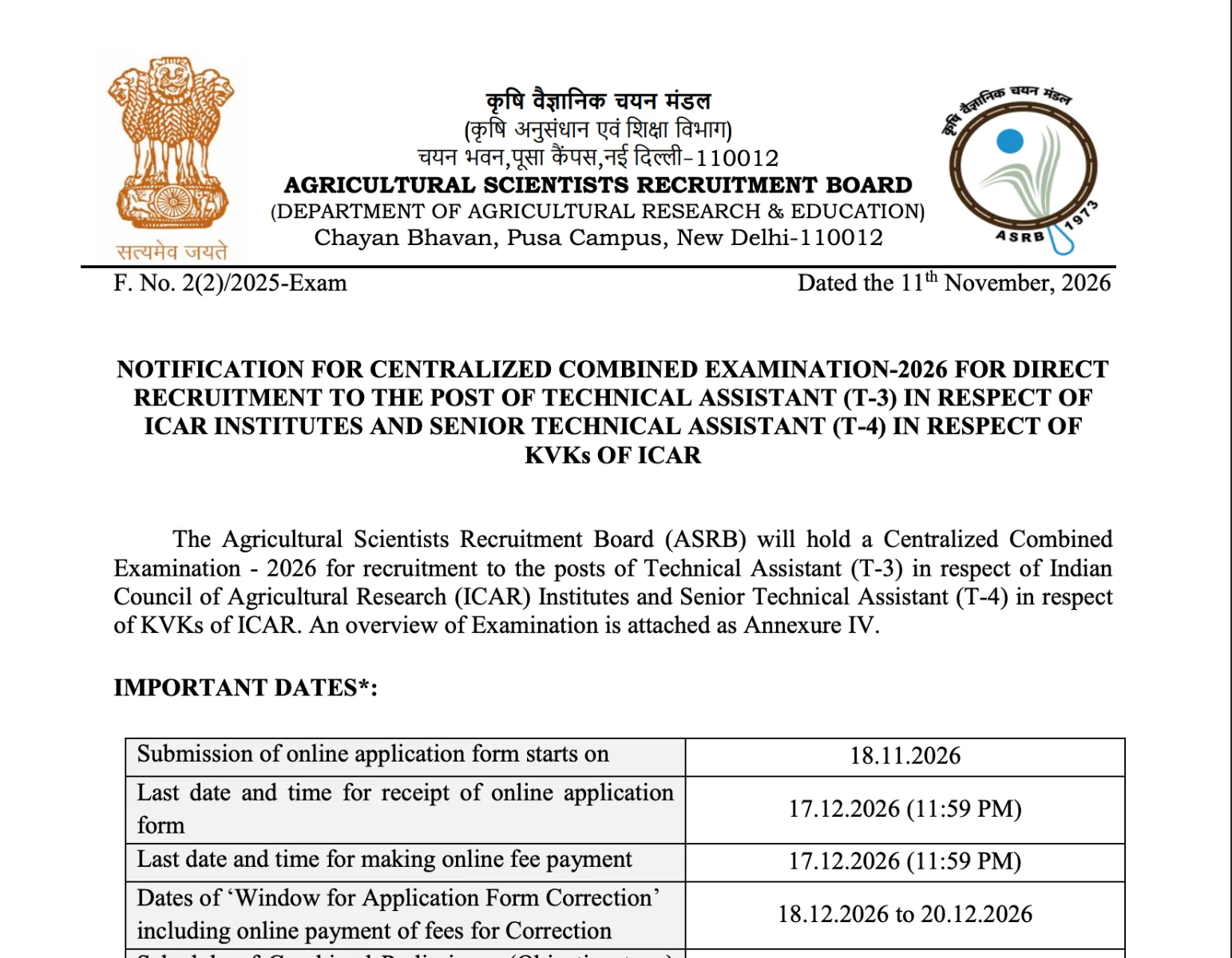
ICAR T-3 T-4 Recruitment 2026: 1,393 Vacancies, Apply Online
ICAR Technical Assistant T-3 T-4 Recruitment 2026: Check 1,393 vacancies, eligibility, qualification, salary, age limit, application fee, apply online and exam details.
सस्य विज्ञान: Modern Nitrogen Management in Cereal Crops
Precision nitrogen application strategies using chlorophyll meters, leaf color charts, and split fertilizer schedules in wheat and rice.
मृदा विज्ञान: Soil Acidity Neutralization & Liming
Comprehensive study notes covering cation exchange capacity and neutralization of acidic soils.
NTA ICAR AIEEA PG 2026 Notification Released
Read complete official guidelines, key highlights, syllabus breakdown, and direct download links.